

Taking your dog on a ferry is usually very doable, but the small details matter. On one route your dog may stay in the car, on another you can book a kennel, Pet Lounge, Pet Den or pet-friendly cabin. The travel documents also depend on where you live and where you are sailing.
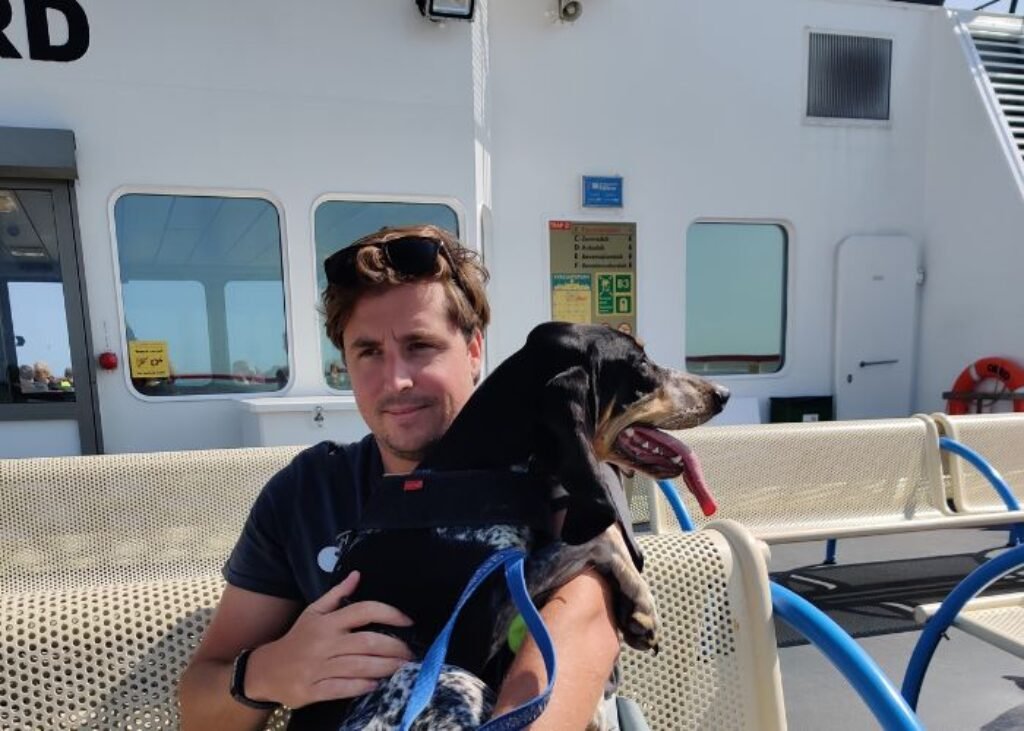
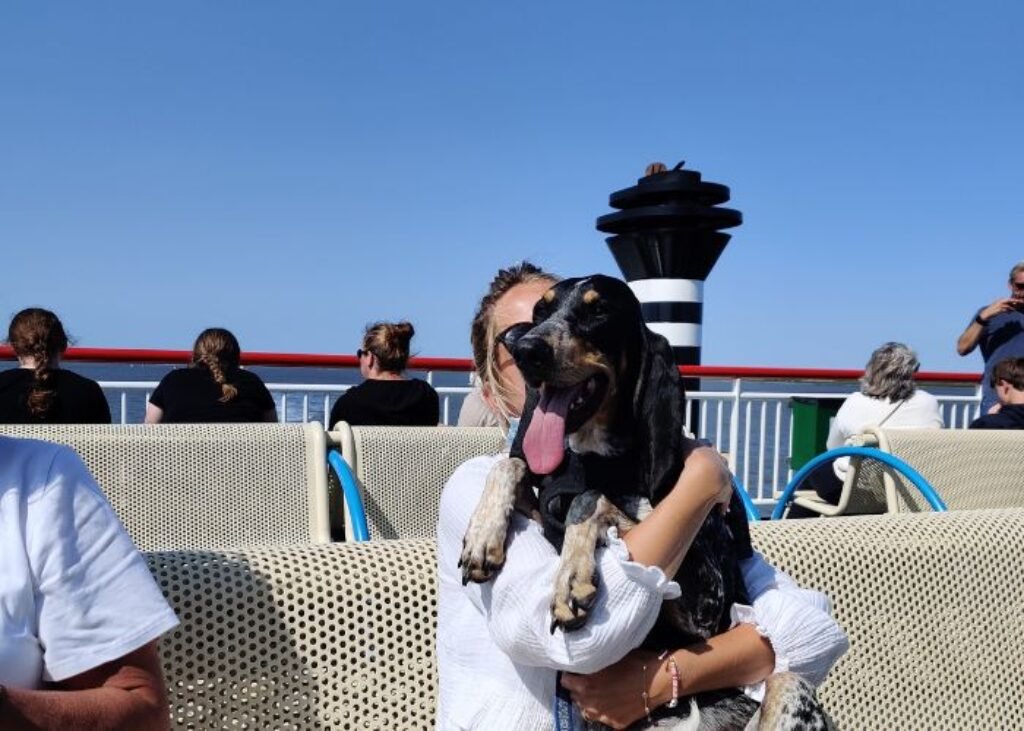
The photos in this guide are from one of our own ferry trips with Fons. From experience, ferry travel can be a very practical way to travel with a dog: you can bring your own car, avoid airport stress and, on some overnight routes, book a pet-friendly cabin so your dog can stay with you.
But you do need to plan properly. Pet spaces are limited, the rules differ per ferry company and cross-border requirements can change. This guide explains the main rules for travelling with a dog by ferry from the UK to France, Ireland, Northern Ireland, the Netherlands and Spain, plus important Ireland–France routes.
Last checked: May 2026. We review this guide regularly, but pet travel rules and ferry-company policies can change.
- Can you take a dog on a ferry?
- Three things to check before booking
- Dog travel documents from Great Britain to the EU
- Travelling with a dog from Great Britain to Northern Ireland
- Tapeworm treatment for dogs
- Where can your dog stay on the ferry?
- Best ferry routes by dog setup
- Brittany Ferries with a dog
- DFDS with a dog
- Stena Line with a dog
- P&O Ferries with a dog
- Irish Ferries with a dog
- Best ferry options with a dog
- Dog on the ferry to France
- Practical tips from experience
Quick answer: can you take a dog on a ferry?
Yes, dogs are allowed on many ferries between the UK, Ireland and mainland Europe, but you normally need to book them in advance and follow both the ferry company’s rules and the destination country’s entry rules.
The biggest difference is where your dog is allowed to stay during the crossing. Depending on the route, ship and operator, your dog may have to:
- stay in your vehicle during the crossing;
- stay in an onboard kennel;
- travel with you in a pet-friendly cabin;
- use a dedicated Pet Lounge or Pet Den;
- stay in a designated outside pet area only when accompanied.
For short crossings, such as Dover–Calais, dogs often remain in the car unless a dedicated pet lounge option is booked. For longer or overnight crossings, pet-friendly cabins and kennels can make a big difference, especially if your dog is nervous, older or simply used to being close to you.
Before you book: the three things to check
Before choosing a ferry, check these three things first:
- The official pet travel rules for the country you are entering.
- The ferry company’s pet policy for your exact route and ship.
- Where your dog will stay onboard: car, kennel, pet cabin, Pet Lounge or Pet Den.
Do not assume that all ships from the same ferry company have the same pet setup. On one route, a company may offer pet-friendly cabins. On another, the dog may need to stay in the car.
It is also worth choosing the ferry around your dog, not just around the shortest crossing. A calm dog may be fine in the car on a short Channel route. For a nervous dog, an older dog or a long overnight sailing, a pet-friendly cabin can make the whole journey much easier.
Dog travel documents from Great Britain to the EU
If you live in England, Scotland or Wales and travel with your dog to an EU country, you should normally arrange an Animal Health Certificate through your vet before each trip.
For GB residents, the rules around EU pet passports have become stricter. GOV.UK now warns that people living in England, Scotland or Wales should not rely on a pet passport, even if it was issued in the EU, because the pet may be refused entry into the EU. To avoid problems, GB residents should arrange an Animal Health Certificate when travelling from Great Britain to the EU.
For a dog travelling from Great Britain to the EU, the usual requirements are:
- a microchip;
- a valid rabies vaccination;
- an Animal Health Certificate, unless another accepted document applies to your situation;
- tapeworm treatment if the destination or return journey requires it;
- arrival through an approved travellers’ point of entry.
An Animal Health Certificate is usually valid for entry into the EU for 10 days from the date of issue, for onward travel within the EU for up to 6 months, and for re-entry to Great Britain for up to 6 months. You need a new certificate for each trip from Great Britain to the EU.
If you are preparing a wider UK–EU crossing, our UK to Europe by ferry passport, ETA and border checklist is also worth reading alongside the pet travel rules.
Travelling with a dog from Great Britain to Northern Ireland
Travel from Great Britain to Northern Ireland has different rules from travel to the EU. If you are taking a dog, cat or ferret from England, Scotland or Wales to Northern Ireland, you need a Northern Ireland Pet Travel Document.
With a Northern Ireland Pet Travel Document, your pet must be microchipped, but it does not need a rabies vaccination or tapeworm treatment for the GB to Northern Ireland journey. These rules also apply to assistance dogs.
If you live in Northern Ireland, the rules for travel to and from Great Britain are simpler, but your pet must still be microchipped. Always check the latest DAERA and GOV.UK guidance before travelling, especially if you plan to continue from Northern Ireland into Ireland or the EU.
Tapeworm treatment for dogs
Tapeworm treatment is one of the easiest details to get wrong, because it depends on your destination and direction of travel.
A vet must treat your dog for tapeworm and record it in the correct travel document if you are travelling to Finland, Ireland, Malta, Northern Ireland unless you have a Northern Ireland Pet Travel Document, or Norway. The treatment must normally be given no less than 24 hours and no more than 120 hours before arrival.
Dogs also usually need tapeworm treatment before entering Great Britain, unless they are coming directly from Finland, Ireland, Northern Ireland, Malta or Norway.
Because the treatment window is specific, do not leave this until the last minute. If the timing is wrong, you may not be allowed to travel.
Where can your dog stay on the ferry?
The practical question is often not whether dogs are allowed, but where they are allowed during the crossing.
| Pet option | What it means | Best for |
|---|---|---|
| Dog stays in the car | Your dog remains in your vehicle during the crossing. Access to the car deck is usually restricted during sailing. | Short crossings, calm dogs, vehicle passengers |
| Onboard kennel | Your dog is booked into a kennel area. You may be able to visit at set times or with crew permission. | Longer crossings where cabins are unavailable or not needed |
| Pet-friendly cabin | Your dog stays with you in a designated cabin. These cabins are limited and usually sell out early. | Overnight sailings, nervous dogs, families, longer routes |
| Pet Lounge / Pet Den | A dedicated onboard area where you can sit with your dog on selected routes. | Short crossings where you do not want your dog left in the car |
| Designated outside pet area | A deck or small exercise area where dogs can be walked, usually with restrictions. | Longer crossings, cabin/kennel routes |
Pet-friendly cabins are usually the most comfortable option, but there are not many of them. If you are travelling in the summer, during school holidays or on an overnight route, book as early as possible.
Best ferry routes by dog setup
If you are still choosing the route, start with the type of journey that suits your dog best. The fastest crossing is not always the most relaxed option.
| Traveller need | Best route type |
|---|---|
| Shortest time in transit | Dover–Calais / Dover–Dunkirk |
| Dog can stay with you | Pet Lounge / Pet Den / pet-friendly cabin routes |
| Overnight comfort | Harwich–Hook, Hull–Rotterdam, Newcastle–Amsterdam, Brittany Ferries |
| Western France | Brittany Ferries from Portsmouth, Poole or Plymouth |
| Foot passenger with dog | Check carefully - often kennel/cabin required |
Below, we explain the main ferry-company differences in more detail. This is where the exact route and ship matter most: one operator may offer pet-friendly cabins on an overnight route, while another may require dogs to stay in the vehicle on a shorter crossing.
Brittany Ferries with a dog
Brittany Ferries is one of the more pet-friendly ferry operators for longer crossings from the UK to France and Spain. Depending on the ship and route, your dog may be able to travel in your vehicle, in an onboard kennel or in a pet-friendly cabin.
This is especially useful on longer routes such as Portsmouth–Caen, Portsmouth–St Malo, Portsmouth–Cherbourg, Plymouth–Roscoff and the UK–Spain crossings. On some ships, pets can stay in pet-friendly cabins with their owners. On others, the options may be more limited.
Brittany Ferries makes clear that pet accommodation is limited, particularly in summer, so book early if you want a cabin or kennel. Dogs are generally not allowed in normal public areas, except registered assistance dogs, and may need to wear a muzzle when outside the vehicle, kennel or pet-friendly cabin.
If you are still choosing the best crossing, start with our main guide to the ferry to France from the UK, where we compare the main Channel and western France routes.
If you want to avoid the busiest Dover corridor, our guide to Dover alternatives via Portsmouth and Plymouth may help you choose a calmer route to western France.
If you are considering a longer Brittany Ferries crossing, our Brittany Ferries cabins, tickets and upgrades guide can also help you decide whether a cabin is worth booking.
Check the latest Brittany Ferries pet guidance here: travelling with a pet to France or Spain and onboard kennels and pet-friendly cabins.
DFDS with a dog
DFDS pet rules depend heavily on the route.
On the short Dover–France routes, dogs usually remain secured inside the vehicle during the crossing. Access to the car deck is normally restricted while sailing, although staff may be able to advise in specific situations.
Newhaven–Dieppe is a longer crossing, so it is worth paying closer attention to the pet accommodation options. DFDS lists pet-friendly accommodation on selected routes, including Newhaven–Dieppe and Newcastle–Amsterdam. Depending on your booking, pets may be able to stay in a vehicle, kennel or pet-friendly cabin.
On Newcastle–Amsterdam, DFDS offers pet-friendly cabins where your dog can stay with you during the overnight crossing. These cabins can accommodate up to two medium-sized dogs and sleep up to four people. There are also designated outside areas where dogs can be walked during much of the crossing.
Travelling from northern England? See our Newcastle to Amsterdam ferry guide for more route details.
Check the latest DFDS pet guidance here: DFDS pet travel and DFDS pet-friendly cabins on Newcastle–Amsterdam.
Stena Line with a dog
Stena Line is an important operator for dog owners travelling between the UK, Ireland and the Netherlands.
On Harwich–Hook of Holland, dogs can travel by car or as foot-passenger pets, but the exact conditions differ. If you travel by car, you may be able to choose between leaving your dog in the vehicle, booking a kennel or booking a pet-friendly cabin. Foot passengers travelling with pets must book suitable pet accommodation, such as a kennel or pet-friendly cabin.
Stena also offers pet-friendly options on several Irish Sea routes. These can include pet-friendly cabins on selected routes and a Pet Lounge on some Scotland–Northern Ireland crossings. As always, check the route and ship before booking.
If the Netherlands is your destination, compare the main options in our ferry to the Netherlands from the UK guide.
For route details, sailing times and booking context, see our Harwich to Hook of Holland ferry guide.
We also wrote about our own Harwich to Hook of Holland overnight Rail & Sail experience, which gives a better feel for the route and onboard rhythm.
For a closer look at the onboard setup, see our cabins, tickets and upgrades guide for the Harwich–Hook of Holland ferry, including cabin types and pet-friendly cabin options.
Check the latest Stena Line pet guidance here: Can I bring my pet? and Stena Line pet cabins.
P&O Ferries with a dog
P&O Ferries has different dog rules on its main routes.
On Dover–Calais, dogs normally remain in the vehicle during the short crossing unless you have booked access to the Pet Lounge. The Pet Lounge is for dogs only; other pets remain in the vehicle. P&O also states that it does not transport UK banned dog breeds.
On Hull–Rotterdam, dogs cannot simply remain in the vehicle for the overnight crossing. They must be booked into onboard kennels or dog-friendly cabins. The dog-friendly cabins are limited, so this is one to book early if you want to sleep near your dog.
On Cairnryan–Larne, pets are welcome and can travel free of charge, but they must remain in the vehicle during the crossing.
We have also written about our own Hull–Rotterdam ferry experience, which gives more context on the overnight crossing.
Check the latest P&O Ferries pet guidance here: P&O travelling with a pet and P&O dog-friendly cabins on Hull–Rotterdam.
Irish Ferries with a dog
Irish Ferries is a key operator for Dover–Calais, Ireland–Britain and Ireland–France dog travel.
On Dover–Calais, Irish Ferries welcomes pets travelling with motorists and motorcyclists, but pets must be declared at the time of booking. Irish Ferries accepts a maximum of five pets on a single motorist booking. The operator also has a Pet Den option on the route, which can be useful if you do not want your dog to stay in the car for the crossing.
On Ireland–Britain routes, the options vary by ship. Depending on the crossing, your pet may stay in the vehicle, a kennel, a Pet Den or a pet-friendly cabin. Irish Ferries has been adding more dedicated pet areas and pet cabins on selected ships, including pet cabins on James Joyce and Isle of Inisheer.
On Dublin–Cherbourg, pet facilities depend on the ship. On W.B. Yeats, pets must stay in a pre-booked kennel. On Isle of Inisheer, pet cabins may be available, subject to availability, with access to an outside deck area.
Check the latest Irish Ferries pet guidance here: Irish Ferries pet travel on Dover–Calais, Ireland–Britain pet travel and Ireland–France pet travel.
Best ferry options with a dog
The best ferry route with a dog depends less on the operator name and more on the kind of crossing you are planning.
Best for a short crossing
For short UK–France crossings, Dover–Calais and Dover–Dunkirk are usually the quickest options. If your dog is calm in the car, this can be straightforward. If you would rather stay with your dog, look at Pet Lounge or Pet Den options on selected Dover–Calais sailings.
Best for an overnight crossing
For longer sailings, we would usually look first for a pet-friendly cabin. Routes such as Harwich–Hook of Holland, Hull–Rotterdam, Newcastle–Amsterdam and selected Brittany Ferries crossings can work well if you book the right pet accommodation early.
Best if you are travelling as a foot passenger
Foot passengers need to be especially careful. Some routes only allow pets with vehicles, while others require foot passengers with dogs to book a kennel, cabin or dedicated pet space. Always check this before booking, not at check-in.
Best if your dog gets stressed
If your dog does not like being left alone, a pet-friendly cabin or Pet Lounge/Pet Den is usually better than leaving them in the car. On overnight sailings, a pet-friendly cabin can make the trip feel much more like a normal travel day rather than a stressful wait.
Dog on the ferry to France
France is one of the most popular ferry destinations for UK dog owners. You can take your dog on many ferries to France, but you need to meet the EU entry requirements and follow the ferry company’s onboard rules.
From Great Britain, this usually means arranging an Animal Health Certificate, making sure the microchip and rabies vaccination are correct, and checking whether tapeworm treatment is needed for your return to Great Britain.
France also has specific rules for certain restricted dog categories. Some attack-type dogs without recognised pedigree may not be imported. Other restricted breeds may require recognised pedigree documents and must follow local rules, including muzzle and lead requirements. Check the official French customs guidance before travelling with a breed that may be restricted.
You can read the official French customs pet guidance here: travel: coming to France with your pet.
Banned and restricted dog breeds
Some countries and ferry companies restrict certain dog breeds. The UK has its own list of banned dog breeds, and ferry companies may refuse to carry dogs that are banned under UK rules. France and some other European countries also have rules for specific dog categories.
If your dog could fall into a restricted category, check official government guidance well before you book. Do not rely only on general travel blogs or forum advice.
Useful official links:
Practical tips for taking your dog on a ferry
From our own experience, the ferry can be a very comfortable way to travel with a dog, but a bit of preparation makes a big difference.
With Fons, the biggest difference was simply knowing in advance where he was allowed to be during the crossing. Once that was clear, the ferry felt much less stressful than flying or trying to rush the journey.
- Book early: pet-friendly cabins, kennels and lounge spaces are limited.
- Check the exact ship: pet facilities can differ by vessel, even on the same route.
- Arrive early: pet document checks can take extra time, especially on international routes.
- Bring water and a bowl: especially if your dog will stay in the car or kennel.
- Use familiar bedding: it helps your dog settle and can be useful if there is an accident.
- Walk your dog before check-in: access to walking areas may be limited once boarding starts.
- Do not overfeed just before sailing: especially if your dog is prone to travel sickness.
- Bring a lead and muzzle: some ships or countries require dogs to be muzzled in certain areas.
- Keep documents easy to reach: do not pack the AHC, pet passport or treatment records deep in the car.
Assistance dogs on ferries
Recognised assistance dogs are usually treated differently from pets and are generally allowed in more areas of the ship. However, they still need to meet the relevant travel document, microchip, vaccination and entry requirements for the country you are travelling to.
If you travel with an assistance dog, contact the ferry company before booking so they can confirm the correct process for your route and ship.
Questions about taking a dog on a ferry
Can dogs go on ferries from the UK to France?
Yes, dogs can travel on many ferries from the UK to France. Depending on the operator and route, your dog may stay in the car, use a Pet Lounge or Pet Den, or travel in a kennel or pet-friendly cabin. You must also meet the official EU pet travel requirements.
Can my dog stay with me on the ferry?
Sometimes. On selected routes you can book a pet-friendly cabin, Pet Lounge or Pet Den where your dog can stay with you. On many short crossings, however, dogs remain in the vehicle unless a dedicated pet area has been booked.
Do I need an Animal Health Certificate?
If you live in England, Scotland or Wales and travel with your dog to the EU, you should normally arrange an Animal Health Certificate for each trip. Do not assume an EU pet passport is still valid for GB residents.
Do dogs need tapeworm treatment before ferry travel?
It depends on the destination and direction of travel. Dogs need tapeworm treatment for travel to certain countries, including Ireland, Malta, Finland and Norway, and usually before entering Great Britain unless travelling directly from Ireland, Northern Ireland, Finland, Malta or Norway. Check the official rules and timing before you travel.
Can dogs travel in the car on a ferry?
On some routes, yes. This is common on short crossings such as Dover–France and Cairnryan–Larne. On longer routes, dogs may need to be booked into a kennel or pet-friendly cabin instead. Access to the car deck is usually restricted during the crossing.
Are pet-friendly cabins worth it?
For overnight crossings, often yes. A pet-friendly cabin lets you stay with your dog and can make the journey much calmer. The downside is availability: there are usually only a limited number of pet cabins, so book early.
Can foot passengers take a dog on the ferry?
It depends on the route. Some ferry routes allow foot passengers with dogs only if a kennel, pet cabin or designated pet space is booked. Other routes are more vehicle-focused. Always check the ferry company’s foot-passenger pet rules before booking.
Final thoughts
Taking your dog on a ferry is often much easier than flying, especially if you are travelling with your own car. You have more luggage space, more control over the journey and, on the right route, the chance to book a cabin or pet area that makes the crossing more comfortable.
The main thing is to choose the route around your dog, not just around the shortest sailing time. For some dogs, a short car-based crossing is perfectly fine. For others, a longer ferry with a pet-friendly cabin may be the calmer and kinder option.
Before booking, check the official government pet travel rules, check the ferry company’s own pet page and make sure you know exactly where your dog will stay onboard.
Have you travelled by ferry with your dog? We would love to hear which route you used and how it worked in practice. Feel free to share your experience in the comments.
Get our latest ferry guides, route updates and travel tips in your Google feed. Add FerryGoGo as a preferred source in Google, and follow us in Discover when Google shows the option.











I do not see Condor Ferries mentioned in the information.
This article provides a comprehensive guide on travelling with dogs on ferries. It emphasizes that the rules vary among ferry companies, making it essential to check the specific regulations for each company. While some ferry companies have strict rules regarding pets, many do allow dogs on board, albeit subject to certain conditions. Some ferries have pet-friendly cabins, while others have designated areas or decks for dogs. It is important to contact the vet well in advance to understand the requirements and vaccinations needed for the trip, as they may differ depending on the destination. Breed restrictions also exist in certain countries, such as the UK, France, and Norway. Overall, this article serves as a valuable resource for dog owners planning to travel by ferry.
Thanks ‘Dog Kennels in Auckland’ =)
Would be awesome if you would link from your site towards this article that you describe as ‘the most comprehensive guide on travelling with dogs on ferries.” ! Much appreciated and we are happy that the guide was able to help you.