

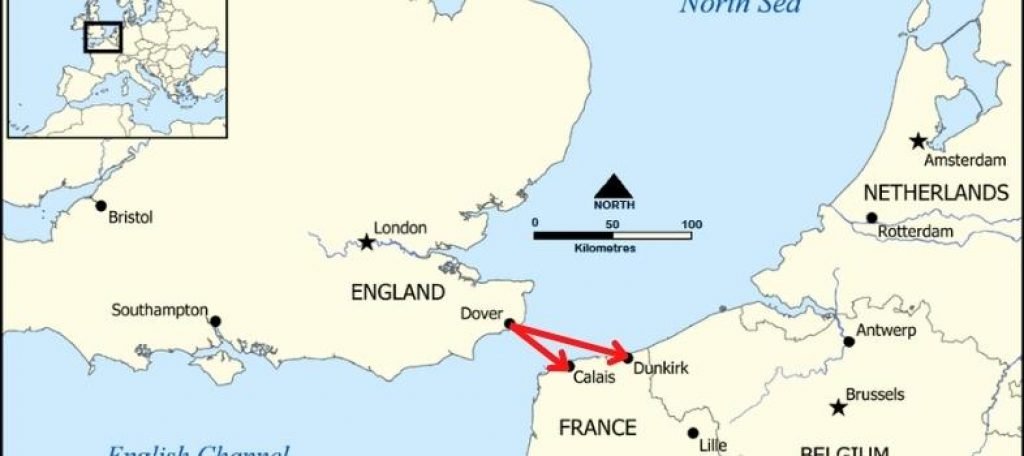
The cheapest way to cross the Channel with a car is usually a short ferry from Dover. Dover-Calais offers the most competition between operators, while Dover-Dunkirk is often similarly priced and can be better placed for Belgium and the Netherlands. LeShuttle is much faster, but it was considerably more expensive in our price check.
Updated September 2026: ferry and LeShuttle prices change constantly according to the date, departure time, demand, ticket conditions and vehicle dimensions. The prices in this article are a dated comparison, not a live price list. Always repeat the search for your own journey.
This guide is primarily for travellers taking a vehicle, including cars, vans, campervans, motorhomes and caravans. If you are travelling without a vehicle, the cheapest option may instead be Eurostar, a coach or a ferry service that accepts foot passengers.
Quick verdict: where should you look first?
If the lowest ticket price is your priority, start by comparing Dover-Calais and Dover-Dunkirk. Then check whether LeShuttle saves enough time to justify any additional cost.
| Crossing | Crossing time | Usually best for | Price position |
|---|---|---|---|
| Dover-Calais | Around 90 minutes | Operator choice, frequent departures and most road trips through France | Often among the cheapest |
| Dover-Dunkirk | Around 2 hours | Belgium, the Netherlands and northern France | Often close to or cheaper than Calais |
| Newhaven-Dieppe | Around 4 hours | Sussex departures, Normandy and some western France journeys | Can reduce the total journey cost |
| LeShuttle | Around 35 minutes on the train | The fastest Channel crossing with a vehicle | Usually priced above the cheapest ferry in our checks |
Times are indicative and exclude check-in, border controls, waiting and boarding. Check your operator confirmation before travelling.
The cheapest ticket is not necessarily the cheapest journey. A different arrival port can save fuel, tolls and several hours of driving. Start with the fare, but make the final decision using the complete door-to-door route.

Our 2026 Channel crossing price check
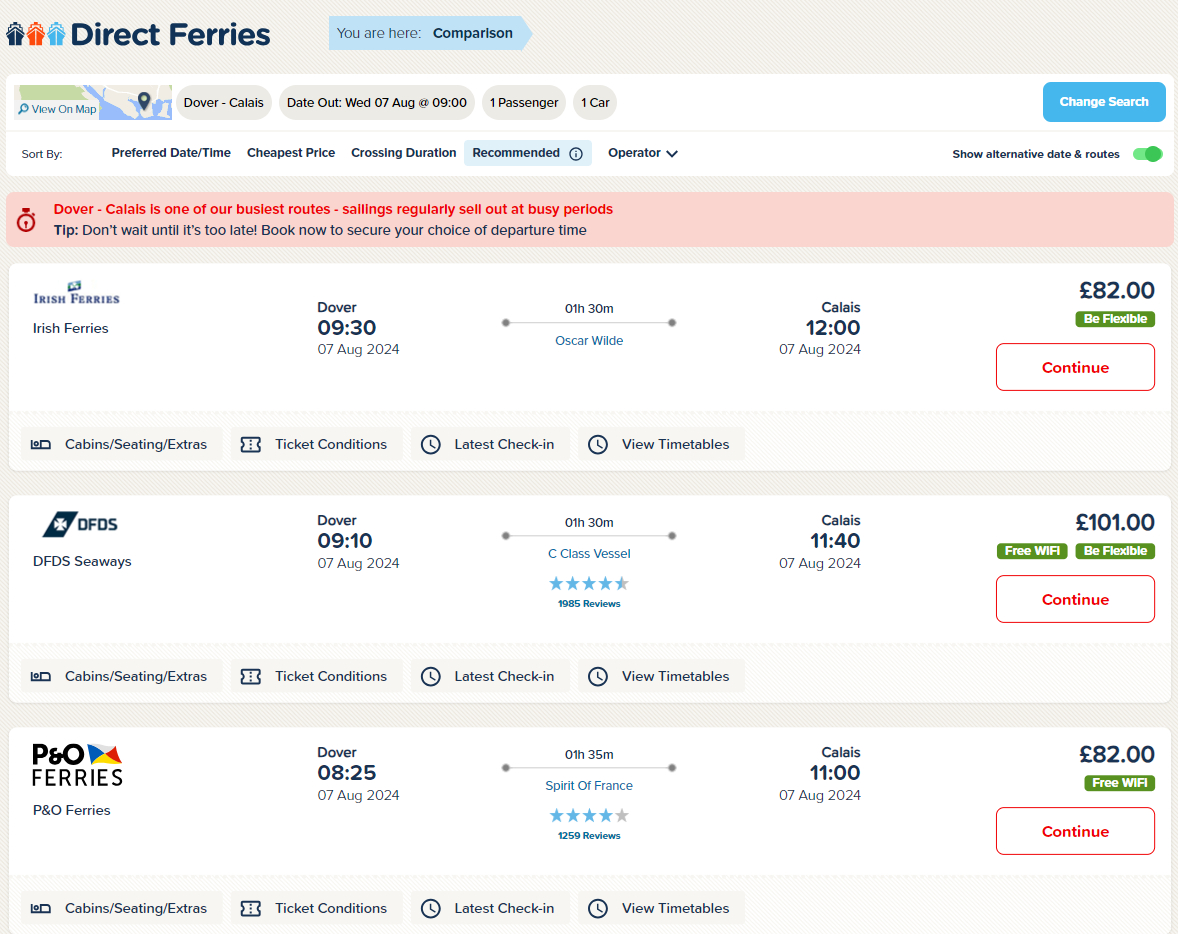
To compare the routes on broadly equal terms, we made test bookings in May 2026 for the same peak-season travel date, using a Volkswagen Golf as the vehicle and keeping the passenger and journey selection consistent.
This was one search for one travel date. It is not a market average and does not prove that the same operator will be cheapest on another day. It does, however, show how large the difference between the ferry and tunnel can be when the short ferry routes are competitively priced.
| Operator and route | Price found | Position in our check |
|---|---|---|
| P&O Ferries, Dover-Calais | Around £82 | Joint cheapest |
| Irish Ferries, Dover-Calais | Around £82 | Joint cheapest |
| DFDS, Dover-Dunkirk | Around £83 | Only slightly more expensive |
| DFDS, Newhaven-Dieppe | Around £100 | Higher fare, but potentially useful arrival port |
| DFDS, Dover-Calais | Around £101 | More expensive on this particular departure |
| LeShuttle, Folkestone-Calais | Around £183 | Fastest, but most expensive |
Prices checked in May 2026 for one selected peak-season journey. These are historical examples, not current from-prices.
P&O Ferries and Irish Ferries were joint cheapest in this snapshot. DFDS Dover-Dunkirk was only £1 more, which illustrates why it is worth comparing routes rather than automatically selecting Calais. A small change in departure time or availability could produce a different winner.
LeShuttle cost more than twice the cheapest ferry fare in this particular search. Its advantage was speed: when we tested it ourselves, the drive-on process and short tunnel journey helped us get back on the road quickly. Whether that is worth paying more for depends on the rest of your journey.
Is Dover-Calais always the cheapest crossing?
No. Dover-Calais is the first route we would check because three ferry operators compete on the crossing and there are many departures. That competition often produces low fares, but Dover-Dunkirk can be cheaper on the same date.
Newhaven-Dieppe can also offer better overall value if Newhaven is closer to home or Dieppe reduces the drive to your destination. From western Britain, a longer ferry from Portsmouth, Poole or Plymouth may cost more as a ticket but save enough driving, fuel or accommodation to become the better-value journey.
Ferry or LeShuttle: which offers better value?
LeShuttle is the speed-led option. The train journey between Folkestone and Calais takes around 35 minutes, while Dover-Calais normally takes around 90 minutes at sea. However, both require time for check-in, border controls, waiting and boarding.
The ferry gives you something the tunnel cannot: a proper break from driving. You can leave the vehicle, walk around, use the onboard facilities and often spend time outside. For families or anyone facing a long drive after arrival, that rest can have real value.
Our practical verdict is straightforward:
- Choose a Dover ferry when the lowest fare and a break from driving matter most.
- Choose LeShuttle when crossing speed and getting back onto the motorway matter most.
- Compare both if you are travelling at a busy time, as availability can change the price difference.
For the actual boarding and tunnel experience, read our first-hand LeShuttle review.
Crossing with a van, campervan, motorhome or caravan
Larger vehicles are where a cheap headline fare can disappear. Ferry companies and LeShuttle ask for the vehicle type and dimensions because these determine the space required on board or on the train.
Measure the vehicle as it will travel, not as it left the factory. Include:
- Roof boxes and roof-mounted bicycles
- Rear bicycle racks
- Tow bars and trailers
- Caravans
- Additional motorhome fittings
Enter the real loaded length and height when booking. Operator categories and limits can change, and choosing the wrong category may lead to an additional charge or problems at check-in.
Private vans and commercial vehicles may also be treated differently. If a van is carrying goods for business use, check whether the operator requires a freight booking rather than a passenger ticket.
For a vehicle larger than a standard car, we would compare Dover-Calais, Dover-Dunkirk and LeShuttle again using the exact dimensions. Do not assume that the operator offering the lowest car fare will also be cheapest for a motorhome or caravan.
What is the cheapest way to take a day trip to France?
A same-day return from Dover can be one of the cheapest ways to visit France with a car. Ferry operators sometimes offer day-return or short-break fares that cost less than buying two ordinary single journeys.
The lowest fares are generally easier to find on quieter weekdays and less convenient departure times. Before booking, check:
- How long you will realistically have in France after check-in and driving time
- The last check-in time for the return journey
- Whether the ticket only permits a same-day return
- The consequences of missing the booked sailing
- Traffic and possible delays around Dover and Calais
Duty-free shopping may add value if you were already planning to make a purchase, but do not treat an allowance as an automatic saving. Our UK ferry duty-free guide explains the current allowances and restrictions.
During busy travel periods, also check our guide to Dover queues, delays and alternatives. A very cheap ticket loses its value if an unrealistic itinerary causes you to miss the crossing.
Six ways to pay less for a Channel crossing
1. Compare Dover-Calais and Dover-Dunkirk
Do not search only for Calais. Dunkirk is close enough to compete directly on price and can be better positioned for some onward journeys.
2. Compare nearby departure times
Moving the journey by a few hours can make more difference than changing operator. Early, late and less popular weekday departures are often cheaper than peak daytime sailings.
3. Book early when your dates are fixed
If you must travel during a school holiday or bank-holiday weekend, booking earlier usually gives you more choice. The cheapest availability on the most convenient departures can sell out.
4. Enter the vehicle correctly
Incorrect dimensions make the comparison unreliable. This matters particularly for vans, trailers, motorhomes, caravans, roof boxes and bicycle racks.
5. Check current offers, but read the conditions
Promotions can make quieter departures attractive, but check the permitted travel dates, vehicle types and ticket conditions. FerryGoGo collects relevant promotions in the Deal dock.
6. Divide the cost across the car
For a family or group, a car crossing can become relatively inexpensive per person because the vehicle often represents a substantial part of the fare. Compare the total group cost rather than one advertised per-person price.
When a longer ferry is cheaper overall
If you live in western England, Wales or South West England, driving to Dover can add a large amount of fuel, time and motorway mileage before the crossing even begins. The same applies if your destination is Normandy, Brittany or France’s Atlantic coast.
A ferry from Portsmouth, Poole, Plymouth or Newhaven may have a higher ticket price but reduce:
- The drive to the UK port
- The onward drive in France
- Fuel and possible toll costs
- The need for an overnight hotel
- Driver fatigue
We experienced the value of this broader calculation when travelling from Portsmouth to Cherbourg on Santoña. Car trouble forced us to change our plans, and the flexible ticket proved genuinely useful. On a longer road trip, flexibility can be part of the value rather than an unnecessary extra.
Use our guide to alternatives to Dover or the wider UK-France route comparison before assuming that the lowest Dover fare produces the cheapest complete journey.
Frequently asked questions
What is usually the cheapest way to cross the Channel with a car?
Dover-Calais and Dover-Dunkirk are normally the first routes to compare. In our May 2026 price check, P&O Ferries and Irish Ferries on Dover-Calais were joint cheapest, with DFDS Dover-Dunkirk only slightly more expensive.
Is the ferry cheaper than Eurotunnel or LeShuttle?
The ferry was substantially cheaper in our selected comparison, and this is a pattern we have seen frequently. It is not guaranteed, so compare both for your date. LeShuttle may justify a higher fare when saving time is particularly important.
Is Dover-Calais cheaper than Dover-Dunkirk?
Not consistently. The routes are close competitors, and the cheapest can change according to availability and departure time. Dunkirk may also save driving if you are heading towards Belgium or the Netherlands.
When should I book a cheap Channel crossing?
Book early if your dates are fixed or fall during a busy holiday period. If your dates are flexible, compare several days and departure times before deciding.
Are motorhomes more expensive than cars?
They often are because pricing takes account of vehicle type and dimensions. Enter the motorhome’s complete loaded height and length and compare the routes again rather than relying on standard car prices.
The cheapest Channel crossing in summary
- Start with Dover-Calais and Dover-Dunkirk when the lowest car fare is the priority.
- Compare every relevant operator and more than one departure time.
- LeShuttle is normally much faster, but it was the most expensive option in our May 2026 snapshot.
- Use the real loaded dimensions for a van, motorhome, caravan or car carrying external equipment.
- Compare the total journey cost, not only the ticket.
- Consider a western ferry route when it substantially reduces driving in Britain or France.
Our practical recommendation: price Dover-Calais and Dover-Dunkirk first, using your exact passengers, vehicle and travel date. Then compare LeShuttle for speed and the western ferry routes for the total journey. The cheapest fare is a useful starting point, but the best-value crossing is the one that keeps the complete trip affordable and manageable.
Get our latest ferry guides, route updates and travel tips in your Google feed. Add FerryGoGo as a preferred source in Google, and follow us in Discover when Google shows the option.







Good afternoon, we would like to cross the channel on the ferry and take our car with us on the ferry We are coming from Calais to Dover Can you give us an idea is it possible and how much does it cost Approximately Coming to Dover on April 20, 2023
Thank you!
A single trip with car will be around € 80 – € 100 if you book in advance. You can see a test booking here for that particular day: https://prnt.sc/-oedt1HpzEq-