


Duty-free shopping is back on many ferry routes between Great Britain and the EU, but the useful question is not just ‘how much can I buy?’ It is: does the shop fit your route, your car space, your allowance and the border you are actually crossing?
For most UK ferry travellers, duty-free becomes relevant on the way home: wine after a France trip, Irish Ferries shopping on Dublin-Holyhead, Stena Line duty-free on Harwich-Hook of Holland, or a Brittany Ferries boutique browse during a longer crossing from France or Spain.
The rules matter, but so does the ferry route. A quick Dover-Calais hop, a Dublin-Holyhead crossing and an overnight ferry from the Netherlands are very different travel days. The allowance may look similar on paper, but how you shop, carry and store things on board is not the same.
Last checked by FerryGoGo: 7 July 2026. Customs rules, food restrictions and operator shopping services can change, so always check official guidance and your ferry operator before travelling.
Where duty-free shopping actually matters on ferries
Duty-free is not equally important on every ferry. It matters most where there is a proper onboard shop, port shop, pre-order option, longer sailing time, or a strong car-travel culture. In practice, these are the routes where most ferry travellers will notice it.
Calais and Dunkirk to Dover: the classic duty-free ferry corridor
The Short Straits are still the classic duty-free ferry setting. The crossing is short, but the volume is huge: cars, families, day-trippers, holidaymakers and people using northern France as the first or last stop of a longer road trip.
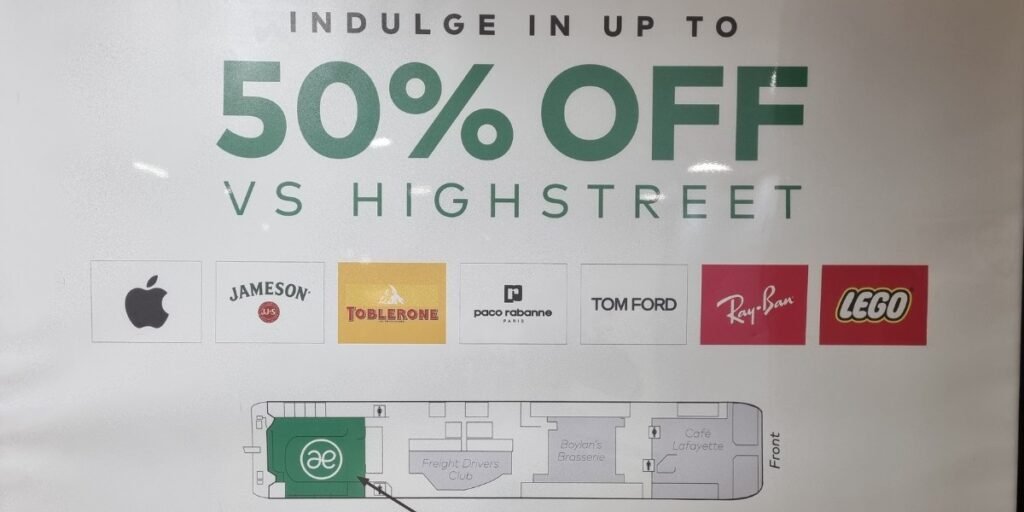
DFDS has Reserve & Collect for Calais and Dunkirk duty-free shops, and Irish Ferries lists duty-free shopping on Dover-Calais. For many travellers, this is less about a romantic onboard boutique and more about a practical stop: pick your wine, spirits, tobacco or gifts, stay inside the allowance, and keep moving.
We have tested the main Dover-Calais options ourselves, including P&O Ferries, DFDS, Irish Ferries and LeShuttle. Our practical takeaway: on a short crossing, everything moves quickly. If duty-free is part of your plan, know your allowance before you get to the shop.
Useful route links: Dover-Calais ferry, Dover-Dunkirk ferry and our Dover-Calais crossing test.
Dublin-Holyhead and Rosslare-Wales: Ireland belongs in this guide
The Republic of Ireland is in the EU, so ferry routes between Great Britain and the Republic of Ireland are very relevant for duty-free. This includes Dublin-Holyhead, Rosslare-Pembroke and Rosslare-Fishguard.
This is an easy one to overlook if you think of duty-free as ‘France shopping’. But the Irish Sea is a big part of the picture. Irish Ferries lists duty-free shopping on Dublin-Holyhead and Rosslare-Pembroke, while Stena Line promotes duty-free on Holyhead-Dublin and Fishguard-Rosslare.
We have travelled Holyhead-Dublin ourselves on the fast Dublin Swift catamaran and returned with Stena Line on a regular ferry. That makes this route useful beyond the allowance table: on the Irish Sea, the operator, vessel type and sailing time can shape the whole onboard experience, including how much time you actually have for the shop.
Useful route links: Holyhead-Dublin ferry, our Dublin Swift experience and our guide to the ferry from Wales to Ireland.
Harwich-Hook of Holland: duty-free as part of a longer crossing
Harwich-Hook of Holland is different from Dover-Calais. It is not a quick dash across the Channel. It is a longer Stena Line crossing where cabins, lounges, food and the onboard shop are part of the travel day.
We have tested Harwich-Hook of Holland in more than one context, including the overnight Rail & Sail journey from London. On the car crossing with Stena Britannica, the Harwich terminal felt fairly limited, and the duty-free shop turned out to be more useful than expected during the wait. That is a very ferry-specific point: sometimes the shop is not just about savings, but about making a dull waiting window a bit more useful.
Useful route links: Harwich-Hook of Holland ferry, our Rail & Sail experience and our Stena Britannica car crossing experience.
Hull-Rotterdam and Newcastle-Amsterdam: shopping is part of the overnight ferry
On overnight routes such as Hull-Rotterdam and Newcastle-Amsterdam, duty-free is not usually the reason to book the ferry. The route decision is more about avoiding a long drive, sleeping on board and landing in the right part of the Netherlands. But once you are on board, the shop is part of the overnight ferry rhythm: cabin, food, a walk around, maybe a browse, then sleep.
For these routes, the FerryGoGo advice is simple: pack your overnight bag before boarding, because the car deck is not freely accessible during the crossing. That also means you should think about where purchases will go. On a longer crossing, duty-free is easy to buy, but you still need to carry it sensibly.
Useful route links: Hull-Rotterdam ferry, Newcastle-Amsterdam ferry, our Hull-Rotterdam experience and our Newcastle-Amsterdam experience.
Brittany Ferries routes to France and Spain: boutique, not booze-cruise
On Brittany Ferries routes, duty-free feels less like a quick port-shop stop and more like an onboard boutique. That makes sense: these are often longer crossings to France or Spain, with cabins, restaurants and more time on board.
For routes such as Portsmouth-Caen, Portsmouth-Saint-Malo, Portsmouth-Cherbourg or Plymouth-Roscoff, the bigger decision is still the route. Are you landing in the right part of France? Is the overnight crossing useful? Do you need a cabin? Duty-free is a nice extra, not the main reason to choose the ferry.
Useful route links: ferries to France from the UK, ferries from Portsmouth to France and ferries to Spain from the UK.
What can you bring back to Great Britain by ferry?
If you are returning to Great Britain by ferry from the EU, your allowance is for personal use or gifts. It is not for resale. You also cannot pool everyone’s allowance into one large undeclared haul in the boot.
These are the main Great Britain personal allowances for travellers arriving by ferry.
Alcohol allowance when returning to Great Britain
- Beer: up to 42 litres
- Still wine: up to 18 litres
- Spirits over 22% ABV: up to 4 litres
- Sparkling wine, fortified wine or other alcoholic drinks up to 22% ABV: up to 9 litres
Note: the spirits and sparkling/fortified wine allowance is a category allowance. You cannot take the full amount from both categories at the same time, but you can split it proportionally.
Tobacco allowance when returning to Great Britain
- Cigarettes: up to 200
- Cigarillos: up to 100
- Cigars: up to 50
- Rolling tobacco: up to 250g
- Tobacco for heating: up to 200 sticks
This is also a category allowance. If you mix tobacco products, the combined amount must stay within the overall limit. If you are under 17, you do not have an alcohol or tobacco allowance.
Other goods allowance
You can usually bring back up to £390 worth of other goods, such as perfume, cosmetics, gifts, electronics, clothes or souvenirs.
Worth knowing: if a single item is worth more than the allowance, you cannot split that one item across several passengers. You may need to pay duty and VAT on the full value.
| Item | Allowance when arriving in Great Britain by ferry |
|---|---|
| Beer | Up to 42 litres |
| Still wine | Up to 18 litres |
| Spirits over 22% ABV | Up to 4 litres |
| Sparkling wine, fortified wine or drinks up to 22% ABV | Up to 9 litres |
| Cigarettes | Up to 200 |
| Cigarillos | Up to 100 |
| Cigars | Up to 50 |
| Rolling tobacco | Up to 250g |
| Other goods | Up to £390 |
Ireland routes: Republic of Ireland is EU, Northern Ireland is different
This is one of the easiest places to make a mistake. The Republic of Ireland is in the EU. Northern Ireland is part of the UK. So not every ‘Ireland ferry’ belongs in the same duty-free bucket.
- Dublin-Holyhead: Republic of Ireland to Great Britain, so EU-to-GB allowances matter when returning to Wales.
- Rosslare-Pembroke and Rosslare-Fishguard: Republic of Ireland to Great Britain, again EU-to-GB.
- Belfast-Cairnryan or Belfast-Liverpool: Northern Ireland to Great Britain, so this is not the same as returning from the EU.
That is why Holyhead-Dublin deserves a proper place in this article. It is a major ferry route, the Republic of Ireland is in the EU, and both Irish Ferries and Stena Line actively promote duty-free shopping on the Irish Sea.
What can you take from Great Britain into the EU?
The return journey is usually where people shop most, but the outward journey matters too. If you are travelling from Great Britain to France, Ireland, the Netherlands, Spain or another EU country, you are entering the EU from outside the EU.
For most ferry travellers entering the EU by sea, the general allowance for other goods is usually €430 per person. Some countries apply lower limits for younger travellers. Alcohol and tobacco allowances are separate.
Alcohol allowance when entering the EU from Great Britain
- Still wine: up to 4 litres
- Beer: up to 16 litres
- Spirits over 22% ABV: up to 1 litre
- Sparkling wine, fortified wine or alcoholic drinks up to 22% ABV: up to 2 litres
Tobacco allowance when entering the EU from Great Britain
- Cigarettes: usually up to 200
- Cigarillos: usually up to 100
- Cigars: usually up to 50
- Smoking tobacco: usually up to 250g
Some EU countries apply lower tobacco limits for travellers arriving by land or sea, so check the country you are entering. France, Ireland, the Netherlands and Spain are the main EU arrival countries for UK ferry travellers.
Food rules: wine is not the same as cheese
This is where ferry shoppers can get caught out. Duty-free allowances are mostly about alcohol, tobacco and goods. Food rules are a separate border issue.
Travelling from Great Britain into the EU: do not assume you can take meat, milk, cheese or dairy products with you. Many personal imports of meat and dairy from outside the EU are restricted or prohibited, with only limited exceptions.
Travelling from the EU back to Great Britain: do not assume you can bring back cheese, meat or dairy either. Since April 2025, Great Britain has had tighter restrictions on many meat and dairy products from the EU and several neighbouring countries.
So the old idea of ‘stock up on French wine and cheese’ needs an update. Wine may be fine within the alcohol allowance. Cheese may not be allowed at all.
FerryGoGo tip: treat meat, cheese and dairy as a separate check before you buy. Do not rely on memory, and do not assume packaged supermarket food is automatically fine.
Onboard shop, port shop or reserve and collect?
Ferry duty-free is not one single thing. The setup depends on the route and operator.
- DFDS: Reserve & Collect is especially relevant for Calais and Dunkirk, where travellers can reserve items before travel and collect at the duty-free shop.
- Irish Ferries: duty-free shopping is listed on Dublin-Holyhead, Rosslare-Pembroke and Dover-Calais, with click-and-collect available on selected services.
- Stena Line: duty-free is promoted on Holyhead-Dublin, Fishguard-Rosslare and Harwich-Hook of Holland.
- Brittany Ferries: the shop is more of an onboard boutique, especially on longer crossings to France and Spain.
For a short Dover crossing, pre-ordering can make sense because time on board is limited. For an overnight ferry, browsing can be part of the crossing. For foot passengers or Rail & Sail travellers, think carefully about what you can comfortably carry after arrival.
What is actually worth buying?
Alcohol and tobacco are usually where the clearest duty-free savings sit, but they are also the categories with the strictest limits. Wine, beer and spirits can be worthwhile on car routes, especially if you have space and you know you are within the allowance.
Perfume, aftershave, cosmetics, confectionery and gifts can also be useful, but compare prices. Sometimes ferry pricing is very good. Sometimes a UK online shop is closer than you expect. The word ‘duty-free’ is not a guarantee that every item is the cheapest you will find.

Our practical view: duty-free is best when it fits naturally into the crossing. A few bottles within the allowance on a car ferry? Fine. A complicated haul that pushes you over the limit, fills the foot passenger luggage and risks a customs problem? Not worth it.
Who should think twice before buying a lot?
For car travellers, duty-free is easy to carry but still needs to stay within the rules. For foot passengers, Rail & Sail users and anyone connecting to a train, it is a different story. A heavy shopping bag can get annoying very quickly once you leave the ferry terminal.
- Foot passengers: buy light. Perfume or gifts make more sense than crates of beer.
- Rail & Sail travellers: remember you still have the train leg after the ferry.
- Families: allowances are individual, but everything often ends up in one boot. Keep receipts and be clear who bought what.
- Campervans and caravans: space is easier, but weight and storage still matter.
- Dog owners: do not let duty-free shopping distract from pet documents, exercise breaks and the practical parts of the route.
What happens if you go over the allowance?
If you go over your allowance, declare it. For Great Britain, you can usually declare goods online before arrival or declare them at the border. If you do not declare goods and you are over the allowance, you risk paying duty and tax, losing the goods, or facing a penalty.
The important detail: duty may apply to the full value in the category, not just the extra bit over the allowance. That can quickly wipe out any saving.
Can you pool allowances with family or friends?
No. Personal allowances are individual. You cannot combine four people’s allowances to bring back one expensive item or one large undeclared stockpile. Alcohol and tobacco allowances only apply to travellers old enough to have those allowances.
This matters on ferry trips because families often travel in one car. The border officer is not interested in how neatly it fits in the boot. What matters is who bought it, what it is, the value, and whether it fits the allowance.
Ferry duty-free checklist before you buy
- Check the allowance for the country you are entering.
- Remember that Republic of Ireland and Northern Ireland are not the same for this topic.
- Do not pool allowances between passengers.
- Keep receipts for alcohol, tobacco, perfume, electronics and gifts.
- Check food restrictions separately, especially meat, cheese and dairy.
- Compare prices before buying, especially for perfume and cosmetics.
- Think about the rest of your journey: car, foot passenger, train or overnight ferry.
- Declare anything over the allowance before or at the border.
Summary: ferry duty-free allowances
| Item | Great Britain to EU allowance | EU to Great Britain allowance |
|---|---|---|
| Beer | Up to 16 litres | Up to 42 litres |
| Still wine | Up to 4 litres | Up to 18 litres |
| Spirits over 22% ABV | Up to 1 litre | Up to 4 litres |
| Sparkling or fortified wine / drinks up to 22% ABV | Up to 2 litres | Up to 9 litres |
| Cigarettes | Usually up to 200, but some countries may apply lower limits | Up to 200 |
| Rolling tobacco | Usually up to 250g, but some countries may apply lower limits | Up to 250g |
| Other goods | Usually up to €430 for sea travellers | Up to £390 |
| Meat and dairy | Many products are restricted or prohibited | Many EU meat and dairy products are restricted or prohibited |
FerryGoGo verdict
Duty-free shopping can be a nice ferry bonus, but it should not take over the trip. The route comes first. Dover-Calais and Dover-Dunkirk are best for quick car-based shopping. Dublin-Holyhead and Rosslare-Wales are important because the Republic of Ireland is in the EU. Harwich-Hook of Holland, Hull-Rotterdam, Newcastle-Amsterdam and Brittany Ferries routes make shopping part of a longer onboard experience.
The best buys are usually alcohol, tobacco, fragrance, cosmetics and gifts. The biggest mistakes are buying more than your allowance, assuming family allowances can be pooled, or forgetting that meat, cheese and dairy are a separate food-border issue.
Our advice: check the route, check the allowance, then shop. A good duty-free saving is only useful if it still works when you reach the border.
Sources checked
- GOV.UK: bringing goods into Great Britain for personal use
- GOV.UK: bringing meat, dairy, fish and animal products into Great Britain
- European Union: alcohol, tobacco and cash when travelling
- Irish Revenue: duty-free allowances from outside the EU
- Irish Ferries: duty-free shopping routes
- Stena Line: duty-free shopping routes and allowances
- DFDS: Reserve & Collect duty-free
- Brittany Ferries: onboard duty-free shopping
Get our latest ferry guides, route updates and travel tips in your Google feed. Add FerryGoGo as a preferred source in Google, and follow us in Discover when Google shows the option.








Great post! I had no idea there were so many restrictions on what you can bring back from a ferry. The tips on alcohol and tobacco limits were really helpful. Looking forward to my trip now!