


There is no direct ferry from the UK to Denmark: the last one, Harwich to Esbjerg, stopped in 2014, and the DFDS ships that still sail from Esbjerg to Immingham only carry freight. You sail to the Netherlands or France and drive on. From the north of England, Newcastle to Amsterdam is the most relaxed choice; from London and the south east, Harwich to Hook of Holland. Count on roughly 8 to 10 hours of driving from the Dutch ports to Copenhagen.
The best routes to Denmark at a glance
| Route | Crossing | Then drive to Copenhagen | Best if you live in |
|---|---|---|---|
| Newcastle to Amsterdam (DFDS) | overnight, about 16 hours | about 800 km, 9 hours via Puttgarden to Rødby | Scotland and the north of England |
| Hull to Rotterdam (P&O) | overnight, about 11 hours | about 860 km, 9.5 hours | Yorkshire and the Midlands |
| Harwich to Hook of Holland (Stena Line) | day or night, from 6.5 hours | about 860 km, 9.5 hours | London and the east of England |
| Dover to Calais or Dunkirk | about 1.5 to 2 hours | about 1,100 km, 11 to 12 hours | the south and south east |
Driving distances and times are our own estimates via Hamburg and the Puttgarden to Rødby ferry, without stops. Check them in your route planner.
Which one we would pick depends mostly on where you start. The night ferries from Newcastle and Hull feel like a hotel night that moves you 500 km in the right direction: you sleep on board and start the drive through Germany fresh. From London, Harwich is closer, and a night sailing to Hook of Holland gets you onto the Dutch motorways early in the morning.
Getting to Denmark from the UK
There is no passenger ferry from Britain to Denmark any more; Harwich to Esbjerg was the last. So the journey is a North Sea or Channel crossing, then the road through Germany, with the option of the Puttgarden ferry at the end for Copenhagen.
Step 1: first to the Netherlands or France
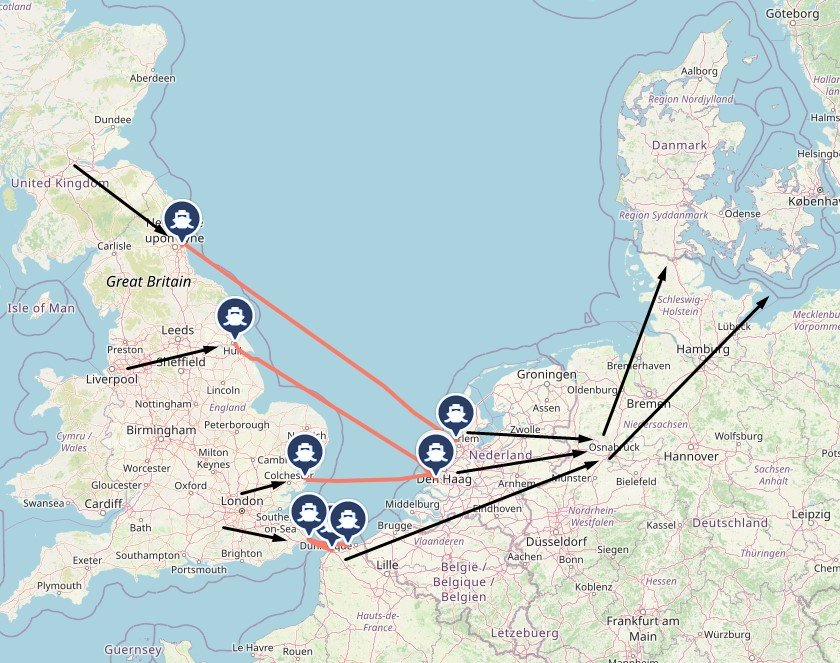
Book a ferry from the UK to the Netherlands or to France and drive on. The map below shows the five sensible combinations.
Ferry map: from the UK to Denmark
Zoom in and click the markers to follow each route to Denmark.
About these crossings
Newcastle to Amsterdam and Hull to Rotterdam are night sailings; Harwich to Hook of Holland sails by day and by night. The short crossing in the top right of the map, Puttgarden to Rødby, is the last piece of the puzzle for Copenhagen.
Starting near Plymouth, Poole or Portsmouth? A Brittany Ferries crossing to Normandy or Brittany can work, but it leaves a long drive; for Denmark the Dutch ports are usually the better start.
Step 1: get a ferry to the Netherlands or France first
Once in the Netherlands or northern France you drive to Denmark. Total time from the UK to the Danish border, ferry included; the Danish border to Copenhagen is another 3 hours 15 minutes.
- Hull to Rotterdam, then Denmark: about 19 hours
- Harwich to Hook of Holland, then Denmark: about 14 hours
- Dover to Calais, then Denmark: about 12 hours
- Newcastle to Amsterdam, then Denmark: about 23 hours
From the south and south-west
From the south and south-west of England the Portsmouth, Poole and Plymouth sailings are an option; compare them on our England to France page or book direct with Brittany Ferries.
Step 2: on to Denmark
From Amsterdam or Rotterdam it is roughly seven hours to the Danish border. For Zealand and Copenhagen, book the Puttgarden to Rødby ferry; the alternative, Rostock to Gedser, is a longer drive from the Dutch side. Both leave northern Germany and cut a large chunk off the road to Copenhagen. You can also stay on the road over the Little Belt and Great Belt bridges, but it adds distance and a toll. We have driven both Scandlines crossings; the report below is from our own trip.
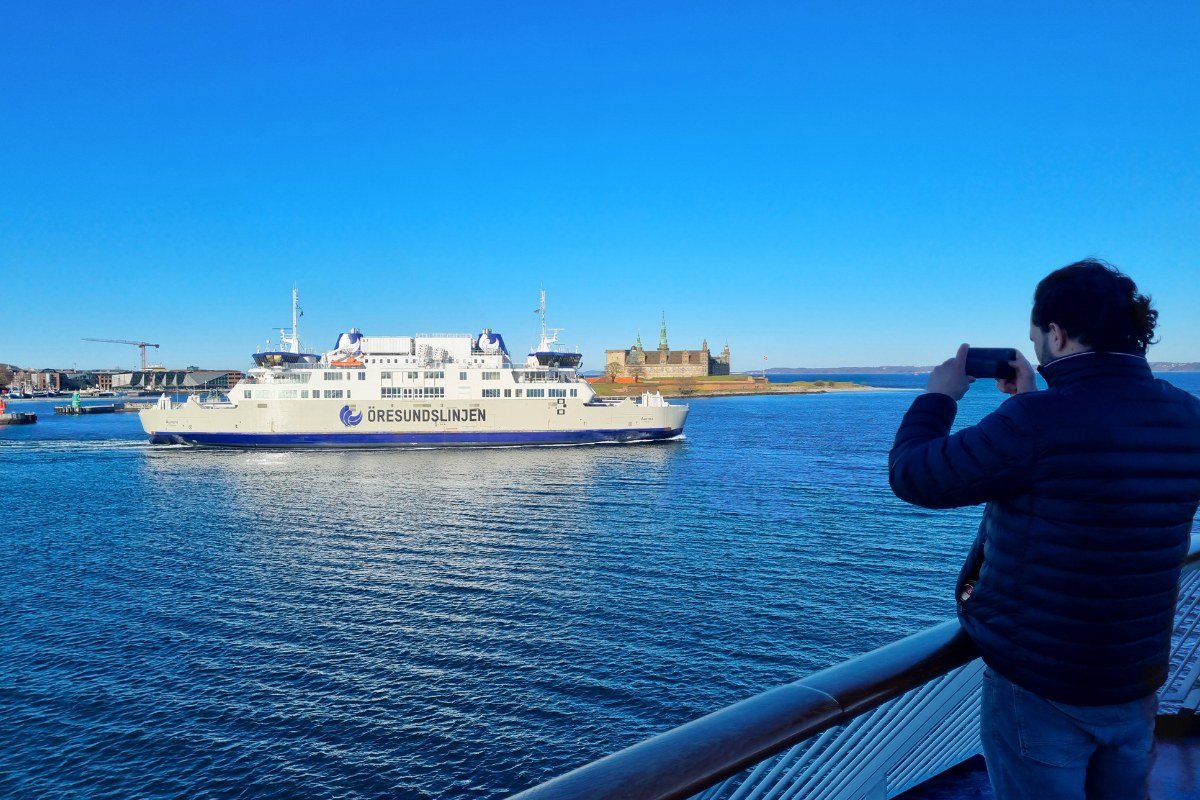
Our ferry adventure: the shortcut to Denmark and Sweden!
Crossings to Copenhagen (Germany to Denmark)
Copenhagen or Jutland?
Denmark is really two journeys. For Jutland (Aarhus, Billund and Legoland, the west coast) you simply drive north from Hamburg via Flensburg: no ferry, about 8.5 to 9 hours from the Dutch ports. For Copenhagen and Zealand you have two options:
- The ferry from Puttgarden to Rødby (Scandlines): 45 minutes, leaving every half hour or so. Booked online it costs from about €48 (Low Price, one fixed sailing) or €61 (Standard, flexible). At the harbour you pay a lot more, so always book ahead. This is the shortest way to Copenhagen and our usual choice.
- All the way by road via Flensburg and the Great Belt Bridge (Storebælt): about 150 km further. The bridge costs DKK 235 one way for a car (about £27), or DKK 205 with automatic number-plate payment.
Coming from Berlin or eastern Germany? Then Rostock to Gedser (about 2 hours) can be handier. And the long-awaited Fehmarnbelt tunnel under the Puttgarden to Rødby crossing is not expected before 2031, so for now the ferry is still the way to go. More options: ferries from Germany to Denmark and our guide to the ferry to Copenhagen.
On board the ferries to Denmark
We have sailed the Amsterdam, Hook of Holland and Rotterdam routes ourselves in the past year. If you are still deciding, our on-board reports show what each ship is like.
In the past, there were several direct ferry routes from the UK to Denmark and Norway. In this post, you’ll find an overview of the historic ferry crossings from the UK to Denmark, such as the Harwich-Esbjerg and the Newcastle-Esbjerg route.
Recap of all options to Denmark
The overview below shows how the journey looks from Scotland, Liverpool or London. Getting your car into Denmark takes 12 to 20 hours door to border, depending on where you start.
Prices and availability
Select the UK as departure in the module below, then the Netherlands or France, for live fares and sailing times on the first leg. The German to Danish crossings are booked separately.
Before you go: what to know in 2026
- Passport: since Brexit you need a passport, not just a driving licence or ID card. It must be less than 10 years old on the day you arrive and valid for at least 3 months after you leave the Schengen area. You can stay up to 90 days in any 180.
- EES: the new EU Entry/Exit System has been fully running since April 2026. The first time you enter, your fingerprints and a photo are taken (at Dover, or on arrival at the Dutch ports), so allow a bit of extra time. ETIAS is not required yet; no start date has been set. See our EES and ETIAS guide.
- Border checks: Denmark has extended its checks at the German border until at least May 2027, and Germany checks its borders too. Keep your passports within reach for spot checks near Flensburg and at Rødby.
- Low-emission zones: Copenhagen, Frederiksberg, Aarhus, Aalborg and Odense have them. Petrol cars are fine. Driving an older diesel? Then register it in advance at miljoezoner.dk, or risk a fine of DKK 1,500.
- Driving: drive on the right, use a UK sticker (not GB) and keep your dipped headlights on, day and night.
- Entertainment: download films or series beforehand. Wi-Fi on board can be expensive, and roaming at sea can be pricey.
- Travelling with young children on a night ferry? We have tips for travelling with kids. Worried about seasickness? See where to sit.
Luggage & pets
On most ferries there are no strict limits on luggage in your car. Pets are welcome for an extra fee; depending on the ship they stay in the car, a kennel or a pet cabin. For Denmark your dog needs the right vaccinations and an animal health certificate. Read more in our guide to travelling with your dog on the ferry.
Ferry to Denmark from the UK: FAQs
Is there a direct ferry from the UK to Denmark?
No. The last passenger ferry, DFDS Harwich to Esbjerg, stopped in 2014, and DFDS Esbjerg to Immingham only carries freight. You sail to the Netherlands or France and drive on to Denmark.
What is the best way to get to Denmark from the UK by car?
From the north of England, Newcastle to Amsterdam overnight; from London and the east, Harwich to Hook of Holland. From the Dutch ports it is about 8 to 10 hours to Copenhagen via Hamburg and the Puttgarden to Rødby ferry.
How long does it take to drive from the UK to Copenhagen?
Allow a long day after the ferry: about 800 to 860 km and 9 to 9.5 hours from Amsterdam, Rotterdam or Hook of Holland, or about 11 to 12 hours from Calais.
Do I need a ferry between Germany and Denmark?
Only if you want the shortest way to Copenhagen: Puttgarden to Rødby takes 45 minutes. For Jutland you drive straight across the land border near Flensburg, and you can also reach Copenhagen by road via the Great Belt Bridge.
Do I need ETIAS for Denmark?
Not yet. ETIAS has no confirmed start date. You do pass through the new EU Entry/Exit System (EES), with fingerprints and a photo on your first entry.


Hello – did there used to be a ferry that went from Scotland to Denmark? we have heard rumours but don’t know if it ever existed. A real shame if it’s no longer around!
Hi Megan,
We really wish there were more UK / Scandinavia connections, now all options are unfortunately ‘indirect’.
How long has the ferry from Newcastle to Amsterdam been going? I never knew there was a connection. It is such a shame there is only one a day; this is really good for people in the North West of England.
Hi William,
There are actually two ships on the route (KING SEAWAYS and PRINCESS SEAWAYS), crossing each other, but because of the distance there are indeed not much departures per day. The route started February 2011.
Yes, I think it is a pity that you can not travel from Scotland directly to the Scandinavian country. however, I think it is worth it to consider at least one ferry connection as I feel like that people are more and more interested again to travel by car and more people like to explore the Scandinavian culture and country.