

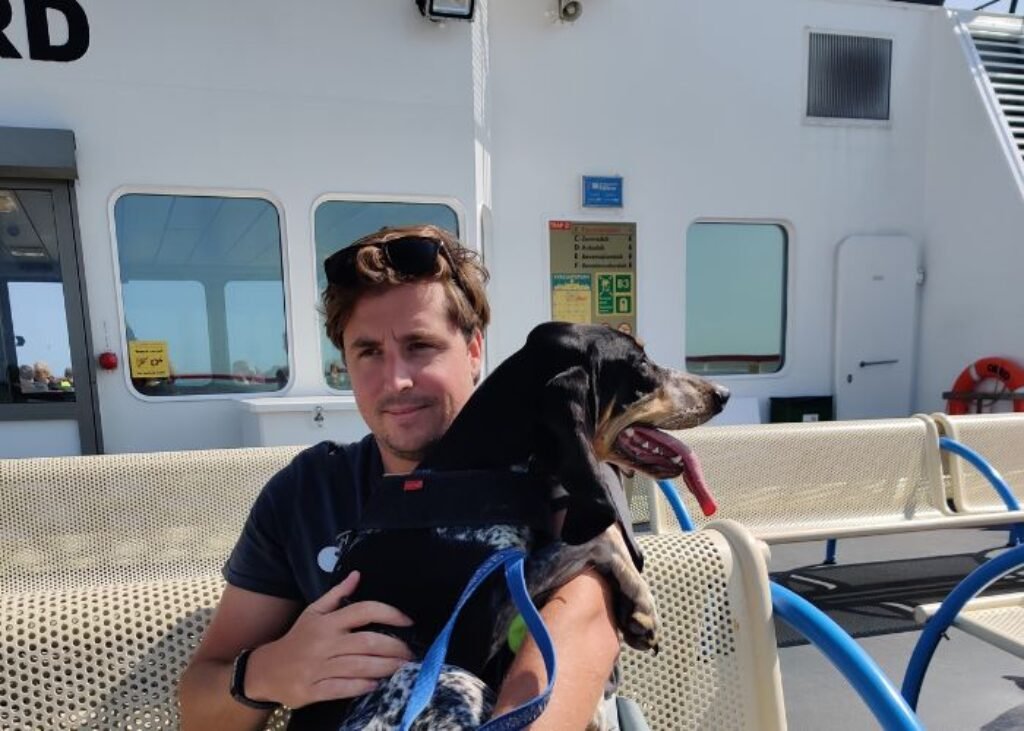
Taking your dog on a ferry is usually very doable, but choosing the right crossing matters. On one route your dog may stay in the car, while another offers kennels, a Pet Lounge, Pet Den or pet-friendly cabin. For a short Channel crossing the car can be perfectly practical; on an overnight ferry, being able to book a cabin with your dog can completely change the journey.
We have travelled by ferry with our own dog, Fons, and that experience shapes the way we look at pet travel. Once you know where your dog will stay, what you need at check-in and whether you can stay together during the crossing, the journey becomes much easier to plan. The ferry also has obvious advantages over flying: you can travel in your own car, bring familiar bedding and supplies, and avoid putting your dog through an airport journey.
That does not mean every pet facility in this guide is something we have personally tested. Pet arrangements vary by route, ship and operator, so we combine our own ferry experience with the latest official ferry-company and government guidance. This guide focuses on the routes most relevant to travellers from Great Britain, including France, the Netherlands, Spain, Ireland and Northern Ireland.
Last checked: 31 August 2026.
We have taken Fons with us on the ferry ourselves. What mattered most was knowing before boarding where he would be allowed during the crossing and having everything he needed easily accessible. For a short trip, staying in a familiar car can work well for a calm dog. For a long or overnight crossing, we would personally look first for a pet-friendly cabin where possible.
That is also how we approach this guide: start with your dog, then choose the route – not the other way around.
- Can you take a dog on a ferry?
- What to check before booking
- Dog travel documents from Great Britain to the EU
- Great Britain to Northern Ireland
- Tapeworm treatment
- Where can your dog stay onboard?
- Which ferry setup is best?
- Brittany Ferries
- DFDS
- Stena Line
- P&O Ferries
- Irish Ferries
- Taking a dog to France
- Our practical tips
Can you take a dog on a ferry?
Yes. Dogs are accepted on many ferries between Great Britain, Ireland and mainland Europe, but you normally need to add your dog to the booking in advance. You also need to comply with the entry rules of the country you are travelling to.
The bigger question is where your dog will spend the crossing. Depending on the route and ship, that might be:
- inside your vehicle;
- in an onboard kennel;
- with you in a pet-friendly cabin;
- with you in a dedicated Pet Lounge or Pet Den;
- in designated pet areas when accompanied.
Those options are not interchangeable. If your dog has to stay in the car, access to the vehicle deck during the sailing may be prohibited or restricted. If you book a pet cabin, your dog can normally stay with you but may still be restricted to the cabin and designated exercise areas.
That is why we would never book purely on sailing time or price when travelling with a dog. The onboard arrangement can matter more than saving half an hour at sea.
Three things to check before booking
Before comparing ferry prices, answer these three questions:
- What documents does your dog need? Check the official rules for the country you are entering and for your return journey.
- What does the exact ferry route allow? Do not assume every ship operated by the same company has the same pet facilities.
- Where will your dog stay? Car, kennel, cabin and pet lounge are very different experiences, particularly on a long crossing.
Think about your dog’s temperament as well. A dog that happily sleeps in the car may be perfectly comfortable on a short crossing. A nervous dog, an older dog or one that dislikes being left alone may be much better suited to a crossing where you can stay together.
Availability matters too. Kennels, pet lounges and especially pet-friendly cabins are limited. On popular summer and school-holiday sailings, the pet accommodation can sell out before the rest of the ship does.
Dog travel documents from Great Britain to the EU
If you live in England, Scotland or Wales and travel from Great Britain to an EU country with your dog, you need an Animal Health Certificate for each separate trip.
This became particularly important after new EU pet-travel rules took effect on 22 April 2026. GB residents should no longer rely on an EU pet passport to enter the EU. Even if you previously used an EU-issued pet passport, arrange an Animal Health Certificate for a journey from Great Britain to the EU.
For most dogs travelling from Great Britain to the EU, the basic requirements include:
- a microchip;
- a valid rabies vaccination;
- an Animal Health Certificate;
- any additional treatment required by the destination country;
- the correct documentation for the return journey.
How long is an Animal Health Certificate valid?
The certificate must be used to enter the EU within 10 days of being issued. Once you have entered the EU, it can be used for onward travel within the EU and for re-entry to Great Britain for up to six months, provided the relevant health requirements remain valid.
You still need a new Animal Health Certificate for the next separate trip from Great Britain into the EU.
Two useful 2026 changes to know about
The April 2026 rules also introduced a limit of five pets per private vehicle for normal non-commercial travel into the EU. The limit for travellers on foot remains five pets.
If someone else is travelling with your pet, extra paperwork may also be required. Under the current rules, the pet must normally travel within five days of the owner and the person accompanying it needs written permission from the owner. If that applies to your trip, check the latest GOV.UK guidance before travelling.
For the wider border and travel-document picture, also see our UK to Europe by ferry passport and border checklist.
Travelling with a dog from Great Britain to Northern Ireland
Northern Ireland has a different system from the EU rules above.
If you live in England, Scotland or Wales and take your dog, cat or ferret from Great Britain to Northern Ireland, you need a Northern Ireland Pet Travel Document.
The document is free and lasts for as long as you own the pet. Your pet needs to be microchipped, but if you are travelling under this scheme it does not need a rabies vaccination or tapeworm treatment for the GB to Northern Ireland journey. The same rules apply to assistance dogs.
There is also an unusual practical step at the ferry port: before leaving Great Britain, you need to scan your pet’s microchip using the scanner provided. The chip number is checked against the Pet Travel Document.
If you live in Northern Ireland, you do not need a Pet Travel Document when travelling to and from Great Britain, but your pet must still be microchipped.
If Ireland is your destination, our ferry to Ireland from the UK guide compares the main crossings to Dublin, Rosslare, Belfast and Larne.
Tapeworm treatment for dogs
Tapeworm treatment is one of the easiest parts of pet travel to get wrong because the rule depends on the destination and the direction of travel.
A vet must give and record the correct tapeworm treatment if you are travelling with a dog to:
- Finland;
- Ireland;
- Malta;
- Northern Ireland, unless you are travelling with a Northern Ireland Pet Travel Document;
- Norway.
The treatment must normally be given no less than 24 hours and no more than 120 hours before arrival.
You also usually need tapeworm treatment before bringing a dog back into Great Britain from most countries. The main exceptions are when travelling directly from Finland, Ireland, Northern Ireland, Malta or Norway.
A useful option for very short trips
If your complete trip is short enough, it may be possible to arrange the return tapeworm treatment before leaving Great Britain. You must still respect the 24 to 120 hour window when you re-enter Great Britain. This can save trying to find a vet abroad for a short break, but check your timings carefully with your vet.
Where can your dog stay on the ferry?
This is usually the most important ferry-specific question.
| Pet option | What it means | Our take |
|---|---|---|
| Dog stays in the car | Your dog remains in the vehicle during the crossing. Access to the vehicle deck is normally restricted and sometimes not possible during the sailing. | Very practical for a calm dog on a short crossing, but less attractive as the crossing gets longer. |
| Onboard kennel | Your dog stays in a kennel area. Access arrangements vary by ship and operator. | Useful on longer routes if a cabin is unavailable, but consider how comfortable your dog is away from you. |
| Pet-friendly cabin | Your dog stays with you in a designated cabin, normally with access to a specific exercise area. | Our preferred setup for an overnight crossing when available. |
| Pet Lounge or Pet Den | A dedicated onboard area for travellers with pets. The exact rules vary, including whether animals need to remain in carriers. | A useful middle ground when you want to stay close to your dog but do not need a cabin. |
| Exercise area | A designated outside or deck area where dogs can be walked under the operator’s rules. | Especially valuable on a long sailing, but check how and when you can access it. |
Do not assume that ‘pet-friendly’ means your dog can follow you throughout the ship. On most ferries, pets are restricted to their booked accommodation and specific exercise areas. Restaurants, bars, shops and normal cabins are usually off limits.
Which ferry setup is best with a dog?
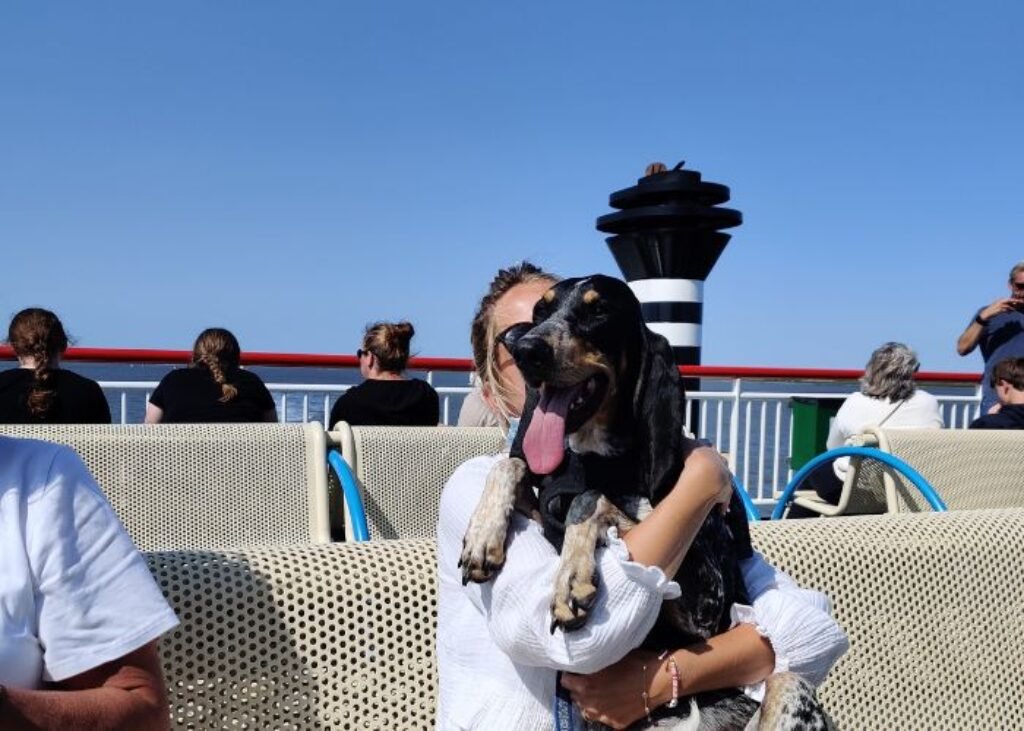
There is no single ‘best ferry for dogs’. We would choose according to the length of the crossing and how your dog travels.
| Route or type | Typical pet setup | Worth considering if… |
|---|---|---|
| Dover-Calais with P&O Ferries | Vehicle or pre-booked Pet Lounge for dogs | You want a short crossing but would prefer to stay with your dog rather than leave them in the car. |
| Dover-Calais with Irish Ferries | Vehicle, Pet Den or kennel depending on how you travel | You want an onboard pet option or are checking whether you can travel with a dog without a car. |
| Dover-France with DFDS | Pet remains in the vehicle | Your dog is happy in the car and you want a straightforward short crossing. |
| Newhaven-Dieppe with DFDS | Vehicle, kennel or pet-friendly cabin | You want more pet-accommodation choice than on the short Dover routes. |
| Harwich-Hook of Holland with Stena Line | Kennel or pet-friendly cabin, with different arrangements for vehicle and foot passengers | You are crossing overnight and want your dog out of the car. |
| Hull-Rotterdam with P&O Ferries | Kennel or dog-friendly cabin | You want an overnight route from northern England and prefer a cabin with your dog. |
| Newcastle-Amsterdam with DFDS | Pet-friendly cabin, dog-friendly kennel or other permitted arrangement depending on the pet and booking | You are heading to or from northern England, Northumberland or Scotland and want to turn the long crossing into overnight travel time. |
| Brittany Ferries to France or Spain | Vehicle, kennel or pet-friendly cabin depending on route and ship | You are planning a longer crossing and pet accommodation is more important than taking the shortest Channel route. |
Pet accommodation can vary by sailing and vessel. The table is a route-choice overview, not a substitute for checking the exact sailing before booking.
Best for a short crossing
Dover-Calais and Dover-Dunkirk are hard to beat if the priority is limiting time at sea. If your dog sleeps happily in the car, there is a lot to be said for keeping the ferry part of the journey short. If you do not want to leave your dog behind on the vehicle deck, P&O Ferries’ Pet Lounge and Irish Ferries’ dedicated pet facilities make Dover-Calais more interesting.
We have tested the three Dover-Calais ferry operators and LeShuttle back-to-back ourselves. You can see how P&O Ferries, DFDS and Irish Ferries compared in our Dover-Calais crossing test. That test was not specifically a dog test, but it gives a much better feel for the operators, ports and onboard experience than a timetable alone.
Best for an overnight crossing
For us, the logic changes once the ferry becomes an overnight journey. If we were travelling with Fons overnight, we would look first for a pet-friendly cabin. Being able to settle into your own space with the dog is very different from leaving them alone for the night.
Harwich-Hook of Holland, Hull-Rotterdam, Newcastle-Amsterdam and selected Brittany Ferries sailings are the obvious routes to investigate.
Best for a nervous dog
If your dog dislikes being left alone, we would prioritise staying together over finding the shortest possible sailing. A Pet Lounge, Pet Den or pet-friendly cabin gives you more control over the situation. For a very nervous traveller, talk to your vet before the trip rather than improvising on the day.
Best for foot passengers with a dog
This needs extra attention because several ferry routes that accept dogs with cars do not necessarily accept dogs travelling with foot passengers.
There are exceptions. Stena Line allows foot passengers with pets on Harwich-Hook of Holland when the correct kennel or pet-friendly cabin is booked. DFDS accepts foot passengers with pets on routes including Newhaven-Dieppe and Newcastle-Amsterdam under the relevant pet-accommodation rules. Irish Ferries also currently lists foot-passenger pet options on selected routes when a kennel or Pet Den is booked.
This is one situation where we would check the operator directly before paying for any connecting rail tickets or accommodation.
Brittany Ferries with a dog
Brittany Ferries is particularly interesting for dog owners because many of its crossings are long enough for the type of pet accommodation to make a real difference.
Depending on the route, vessel and sailing, pets may travel in the car, in an onboard kennel or in a pet-friendly cabin. The choice is not identical on every sailing, so use the actual date and ship when comparing.
If your dog is booked into a pet-friendly cabin, it normally has to remain in that cabin or the designated exercise area rather than accompanying you into normal passenger spaces. Dogs also need to be on a lead and muzzled when moving between the vehicle, cabin, kennel and exercise areas under Brittany Ferries’ current rules.
Brittany Ferries currently asks passengers travelling with a pet to arrive earlier for check-in than normal vehicle passengers, so build that extra port time into the journey rather than comparing only the advertised sailing duration.
We have sailed from Portsmouth to Cherbourg ourselves on Santoña. That was not a dedicated pet test, but it did reinforce why we like the longer western Channel routes when the journey itself matters: you settle onboard, sleep while the ship is moving and arrive much further west in France. You can read our first-hand Portsmouth-Cherbourg experience on Santoña.
For France route choice, see our ferry to France from the UK comparison. If you are looking at a longer crossing, our Brittany Ferries cabins, tickets and upgrades guide gives more context on the cabin options.
For Spain, compare the three main direct routes in our ferry to Spain from the UK guide. On a crossing of that length, we would make pet accommodation one of the first filters rather than treating it as an extra at the end of the booking.
Official information: Brittany Ferries pet travel and pet accommodation options.
DFDS with a dog
DFDS is a good example of why you need to check the route rather than just the operator.
On the Dover-France routes, pets travelling with you normally stay in the vehicle during the crossing and DFDS does not carry foot passengers on those Dover services. For a calm dog and a short Channel crossing, that can be a very straightforward setup.
Newhaven-Dieppe is different. DFDS offers more pet-accommodation options there, including kennels and pet-friendly cabins, and it is also possible to travel with a pet as a foot passenger when the appropriate accommodation has been arranged.
Newcastle-Amsterdam is an overnight route and has pet-friendly cabins where your pet can stay with you. DFDS also has dog-friendly kennels and designated outdoor areas. Its current pet cabins can accommodate up to two medium-sized dogs and sleep up to four people.
We have travelled the IJmuiden-Newcastle crossing ourselves. Our trip was not specifically a dog review, but it gives a good impression of why this much longer route can still make sense: if northern England, Northumberland or Scotland is your destination, the ship does a large part of the travelling while you sleep. See our first-hand Newcastle-Amsterdam ferry experience.
Official information: DFDS pet travel and DFDS pet-friendly cabins on Newcastle-Amsterdam.
Stena Line with a dog
Stena Line has several useful pet options on both the North Sea and Irish Sea, but again the setup differs by route.
Harwich-Hook of Holland is one of the routes we would look at first for an overnight trip with a dog. There are heated onboard kennels and a limited number of pet-friendly cabins, plus an area where dogs can be walked.
Foot passengers can also travel with pets on this route, but they must book an onboard kennel or pet-friendly cabin. Do not simply turn up with a dog and assume it can travel with you.
We know this route well from our own Stena Line crossings, including both car travel and Rail & Sail. If you are deciding whether the extra spend on a cabin is worthwhile, our Harwich-Hook of Holland cabins, tickets and upgrades guide looks much more closely at the onboard accommodation.
On the Irish Sea, Stena Line offers a mixture of cars, kennels, pet-friendly cabins and Pet Lounge facilities depending on the route and ship. The dedicated Pet Lounge is available on the Belfast-Cairnryan Stena Superfast vessels. One important detail is that pets using that lounge need to remain inside an appropriate secure pet carrier during the crossing.
Official information: Stena Line pet travel.
P&O Ferries with a dog
P&O Ferries has three quite different pet setups on its current passenger routes.
Dover-Calais
Dogs can stay in the vehicle for the crossing or travel with their owners in the pre-bookable Pet Lounge. The Pet Lounge is specifically for dogs and includes an outside exercise area, which makes it one of the more interesting options on the short Channel crossing if you do not want to leave your dog in the car.
Hull-Rotterdam
On the overnight Hull-Rotterdam route, dogs need to be booked into an onboard kennel or dog-friendly cabin rather than simply being left in the vehicle for the night. P&O’s dog-friendly cabins are close to the kennel and exercise area.
We have sailed the Hull-Rotterdam route ourselves. One practical lesson from our trip was to take everything you need for the night out of the car before heading upstairs, because the vehicle deck is not somewhere you can simply wander back to when you realise the dog’s bedding, your charger or your overnight bag is still in the boot. See our first-hand Hull-Rotterdam ferry experience.
Cairnryan-Larne
On Cairnryan-Larne, dogs remain in the vehicle during the crossing. If you are travelling from Great Britain into Northern Ireland, remember that the Northern Ireland Pet Travel Document and microchip checks are separate from P&O’s own onboard rules.
Official information: P&O Ferries travelling with a pet and P&O Pet Lounge.
Irish Ferries with a dog
Irish Ferries is relevant on three quite different groups of routes: Dover-Calais, Britain-Ireland and Ireland-France.
Dover-Calais
Irish Ferries requires pets to be added at the time of booking and currently accepts a maximum of five pets on a normal booking.
The operator lists options including keeping your pet in the vehicle or pre-booking dedicated pet accommodation. Importantly for travellers without a car, Irish Ferries’ current guidance also allows foot passengers and motorcyclists with pets when the pet is booked into a kennel or the Pet Den.
That makes Irish Ferries worth checking separately if you are looking for a Dover-Calais option where simply leaving your dog in a vehicle does not suit your journey.
Ireland-Britain
On the Irish Sea, facilities depend on the ship. Options can include the vehicle, kennels, Pet Dens and pet-friendly cabins. Irish Ferries currently has Pet Dens on selected ships and pet cabins on selected vessels including James Joyce.
Dublin-Cherbourg
On the Ireland-France route, the ship matters. Irish Ferries currently states that pets travelling on W.B. Yeats stay in a pre-booked kennel, while Isle of Inisheer offers designated pet cabins subject to availability, with access to an outside deck area.
Official information: Irish Ferries Dover-Calais pet travel, Ireland-Britain pet travel and Ireland-France pet travel.
Taking a dog on the ferry to France
France gives UK dog owners more ferry choice than almost any other destination. You can make the very short hop across the Strait of Dover, take the slightly longer Newhaven-Dieppe crossing or sail from Portsmouth, Poole or Plymouth towards Normandy and Brittany.
That means there is a genuine pet-travel decision to make:
- Keep it short: Dover-Calais or Dover-Dunkirk if your dog is comfortable with the short crossing and the available pet setup.
- Stay with your dog: compare Pet Lounge, Pet Den and pet-cabin options instead of assuming the car is the only choice.
- Travel further west by sea: a Brittany Ferries or Newhaven-Dieppe crossing can reduce the driving you need to do after arriving in France.
Use our ferry to France from the UK guide to compare the main corridors before deciding which pet arrangement works best.
Restricted dog categories in France
France also has additional rules for certain dogs classed as Category 1 or Category 2.
Category 1 attack-type dogs without a recognised pedigree that match certain types, including dogs resembling American Staffordshire terriers, Mastiffs or Tosas, are prohibited from being imported into France.
Category 2 dogs can be subject to specific documentation and control requirements. This includes pedigree American Staffordshire terriers and Tosas, Rottweilers and dogs with Rottweiler characteristics. Rules can include the use of a muzzle and lead in public places.
If your dog could fall into one of these categories, do not rely on a ferry or travel blog alone. Check the latest French customs guidance for travelling with dogs, cats and ferrets before booking.
Banned and restricted dog breeds
Breed restrictions do not stop at the border. Countries can impose their own rules and ferry companies may also refuse to transport certain dogs.
If your dog belongs to a banned or potentially restricted breed, or could be classed as a restricted type based on its physical characteristics, check both the country rules and the ferry company’s conditions before booking.
Practical tips for taking your dog on a ferry
A lot of the difference between an easy ferry trip and a stressful one comes down to preparation rather than the ship itself.
With Fons, simply knowing the onboard arrangement beforehand made the journey much easier. We were not arriving at the port wondering whether he could come upstairs, whether we would see him again during the crossing or what we needed to take out of the car.
- Book pet accommodation early. Cabins, kennels, Pet Lounges and Pet Dens can have much lower capacity than the ferry itself.
- Check the exact route and ship. The operator logo alone does not tell you what pet facilities will be available.
- Walk your dog before boarding. Do not assume there will immediately be somewhere suitable after check-in.
- Keep the paperwork with you. Your AHC, Pet Travel Document, vaccination information and treatment record are no use buried under the luggage in the boot.
- Pack a separate dog bag. Water, bowl, lead, poo bags, towel, bedding, food and any medication should all be easy to reach.
- Bring familiar bedding. A familiar smell can help your dog settle in a kennel or cabin.
- Bring a muzzle even if you do not normally use one. Some operators and destinations require it in specific areas.
- Do not feed a large meal immediately before sailing. This is particularly relevant if your dog is prone to motion sickness.
- Think about temperature. If your dog is staying in the car, follow the operator’s instructions on ventilation and water and consider the weather carefully.
- Allow more check-in time. Travelling with a pet can mean document and microchip checks that other passengers do not have.
Assistance dogs on ferries
Recognised assistance dogs are treated differently from ordinary pets by ferry companies and usually have access to more passenger areas. The exact recognition and documentation requirements differ between operators, so contact the ferry company before travelling.
Do not confuse the ferry company’s onboard access rules with border requirements. Assistance dogs still need to meet the relevant pet-travel health and entry requirements for the country you are entering. For example, the Northern Ireland Pet Travel Document rules explicitly also apply to assistance dogs travelling from Great Britain.
Common questions about taking a dog on a ferry
Can dogs go on ferries from the UK to France?
Yes. Dogs can travel on many ferries from the UK to France. Depending on the route and operator, they may stay in your vehicle, travel in a kennel, use a dedicated Pet Lounge or Pet Den, or stay with you in a pet-friendly cabin. You also need to meet the EU pet-entry requirements.
Can my dog stay with me on the ferry?
On selected ferries, yes. Look for a pet-friendly cabin, Pet Lounge or Pet Den. On many short crossings your dog will otherwise remain in the vehicle, while longer ferries may offer kennels instead.
Do I need an Animal Health Certificate in 2026?
If you live in England, Scotland or Wales and travel from Great Britain to the EU with a dog, cat or ferret, you need an Animal Health Certificate for each separate trip. New EU rules affecting GB residents took effect on 22 April 2026.
Can I use an EU pet passport if I live in Great Britain?
You should not use an EU pet passport to travel from Great Britain into the EU if you are resident in Great Britain. Arrange an Animal Health Certificate instead. Different documentation can still be accepted for the return journey into Great Britain.
Does my dog need tapeworm treatment?
It depends on the destination and direction of travel. Treatment is required for dogs travelling to Finland, Ireland, Malta, Norway and Northern Ireland unless travelling under the Northern Ireland Pet Travel Document scheme. It is also usually required before returning to Great Britain from most countries. The normal treatment window is 24 to 120 hours before arrival.
Can foot passengers take dogs on ferries?
Sometimes, but not on every route. Harwich-Hook of Holland, Newhaven-Dieppe and Newcastle-Amsterdam are examples where foot passengers can travel with pets subject to the relevant booking rules. Irish Ferries also lists foot-passenger pet options on selected services when the required pet accommodation is booked. Always check before buying connecting travel.
Are pet-friendly cabins worth it?
For an overnight crossing, we think they can be. The main benefit is not luxury but being able to keep your dog with you and settle into the journey together. They do cost more and availability is limited, so we would book early if this is important to you.
Our view: choose the crossing around your dog
Travelling by ferry can be one of the easiest ways to take a dog abroad. You can use your own car, carry everything your dog needs and choose a crossing that ranges from a short Channel hop to an overnight journey with your own cabin.
From travelling with Fons ourselves, we would not make the decision purely around the fastest route. For a dog that happily sleeps in the car, keeping the sea crossing short can be ideal. For a dog that wants to stay close to you, a longer ferry with the right pet accommodation may actually be the more relaxed journey.
The order we would use is simple: check the official travel documents first, decide where you want your dog to stay onboard, then compare routes and prices. That avoids finding the perfect fare and only afterwards discovering that the pet arrangement does not work for you.
If you have taken your dog on one of these crossings, feel free to leave a comment with the route, operator and pet setup you used. First-hand experiences from other dog owners are particularly useful where the official rules tell you what is allowed but not what the journey actually feels like.
Get our latest ferry guides, route updates and travel tips in your Google feed. Add FerryGoGo as a preferred source in Google, and follow us in Discover when Google shows the option.










I do not see Condor Ferries mentioned in the information.
This article provides a comprehensive guide on travelling with dogs on ferries. It emphasizes that the rules vary among ferry companies, making it essential to check the specific regulations for each company. While some ferry companies have strict rules regarding pets, many do allow dogs on board, albeit subject to certain conditions. Some ferries have pet-friendly cabins, while others have designated areas or decks for dogs. It is important to contact the vet well in advance to understand the requirements and vaccinations needed for the trip, as they may differ depending on the destination. Breed restrictions also exist in certain countries, such as the UK, France, and Norway. Overall, this article serves as a valuable resource for dog owners planning to travel by ferry.
Thanks ‘Dog Kennels in Auckland’ =)
Would be awesome if you would link from your site towards this article that you describe as ‘the most comprehensive guide on travelling with dogs on ferries.” ! Much appreciated and we are happy that the guide was able to help you.