Getting to Paris by ferry from the UK
There is no direct ferry to Paris. Paris is inland, so the ferry takes you across the Channel or into northern France; after that, you continue by car, train or coach towards the French capital.
That makes this journey slightly different from a normal ferry route guide. The real question is not which ferry sails to Paris?, but which UK-France crossing gives you the best total journey to Paris?
For the complete route network, start with our full guide to ferries from the UK to France. This page filters those options down to the crossings that make most sense for Paris.
For most travellers, the shortlist is simple:
- Dover to Calais – the classic short ferry option, especially from London, Kent and the South East.
- LeShuttle / Eurotunnel – not a ferry, but often the fastest car option if speed matters more than the onboard break.
- Newhaven to Dieppe – useful from the south coast, with a more direct feel into Normandy and onward to Paris.
- Portsmouth to Le Havre – a longer sea crossing, but a logical arrival point for eastern Normandy, Rouen, the Seine valley and Paris-side trips.
- Portsmouth to Caen – not the shortest route to Paris, but a comfortable all-round ferry if Portsmouth works better than Dover for your journey.
If you are travelling without a car, compare ferry options carefully with Eurostar. If you are driving, compare the ferry with LeShuttle / Eurotunnel as well.
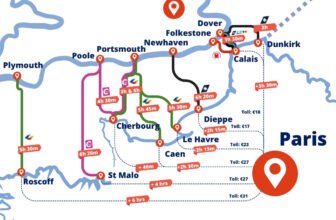
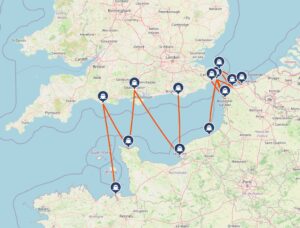
Map: crossings from the UK in the direction of Paris.
This map displays the different routes from Southern England to French coastal cities, which can serve as a starting point for further travel to Paris. It allows you to conveniently zoom in and out to identify the crossings that lead to Paris.
Portsmouth-Saint Malo
Portsmouth-Cherbourg
Plymouth-Saint Malo
Best ferry routes to Paris
The shortest sailing is not always the best route to Paris. You need to look at the full travel day: driving to the UK port, check-in, the crossing itself, border controls, the onward drive in France, and whether you want a proper break from the car.
Dover to Calais – best classic ferry route from London and the South East
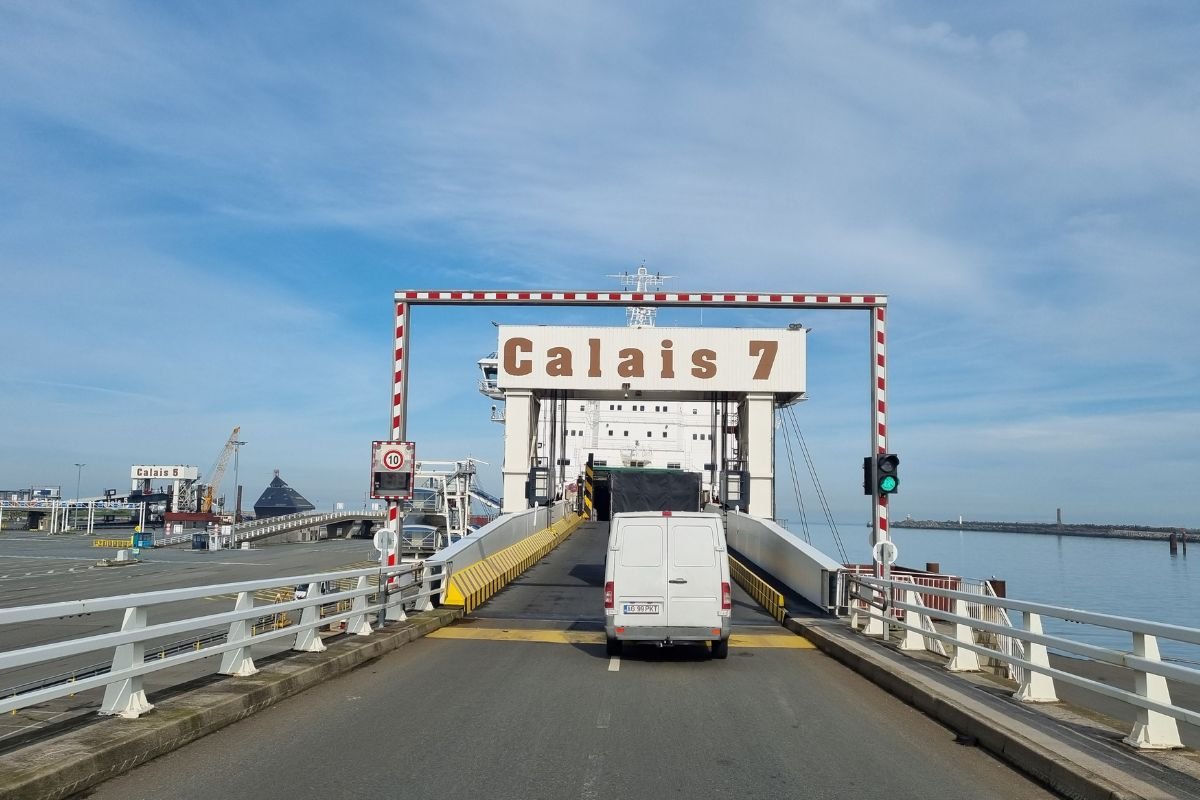
Dover to Calais is usually the most obvious ferry route to Paris if you are starting in London, Kent or the South East. The crossing is short, sailings are frequent, and once you arrive in Calais you continue south by motorway towards Paris.
This route works best if you want maximum flexibility and do not mind doing more of the journey by road. It also gives you a proper ferry break: time to leave the car, stretch your legs, get food, take children to the facilities on board and reset before the French driving starts.
Also compare this route with LeShuttle / Eurotunnel. The tunnel is faster, but the ferry can be more relaxed and is often worth checking on price.
LeShuttle / Eurotunnel – fastest car option, but not a ferry
LeShuttle is not a ferry, but it belongs on this page because many people searching for a ferry to Paris are really trying to find the best way to cross from the UK to France with a car.
You drive onto the train at Folkestone and leave the train at Calais. From there, the onward road journey to Paris is similar to the Dover-Calais ferry option. Choose LeShuttle if speed and convenience matter most. Choose the ferry if you prefer a break from driving, sea views, more space to move around and the chance to compare fares between ferry operators.
Read more in our Eurotunnel, LeShuttle and Eurostar guide.
Newhaven to Dieppe – useful south coast alternative
Newhaven to Dieppe is a good alternative if you are starting from Sussex, parts of Surrey, Hampshire or the south coast and do not want to drive across to Dover. The ferry crossing is longer than Dover-Calais, but Dieppe gives you a pleasant Normandy arrival and a fairly natural onward route towards Rouen and Paris.
This route can also be interesting for travellers without a car, but always check the latest foot passenger rules and onward train connections before booking. For some car-free London to Paris journeys, Eurostar will still be the simpler answer.

Portsmouth routes to Paris
Portsmouth is not always the fastest way to reach Paris, but it can be the most comfortable choice if you live in the south, south west or west of London. It also works well if Paris is part of a wider Normandy or northern France trip rather than a quick city break.
Portsmouth to Le Havre – best Portsmouth route for Paris-side Normandy
Portsmouth to Le Havre is the most logical Portsmouth ferry if Paris, Rouen, Honfleur or the Seine valley are part of your plan. The sailing is longer than Dover-Calais, but you arrive further west and closer to eastern Normandy.
This is not always the fastest door-to-door route from London to Paris. It makes more sense if Portsmouth is a convenient departure port for you, if you prefer a longer sea crossing, or if Paris is part of a wider Normandy road trip rather than a direct city break.
For the full Portsmouth picture, including Caen, Cherbourg, Le Havre and Saint-Malo, see our guide to ferries from Portsmouth to France.
Portsmouth to Caen – comfortable, but not always the fastest for Paris
Portsmouth to Caen is one of the best all-round ferries to Normandy, especially if you want a comfortable crossing and good onward road links. For Paris specifically, it is usually not as direct as Le Havre, Calais or Dieppe, but it can still work well if Portsmouth is your best UK port or if you are combining Paris with Normandy.
Choose Caen if the sailing time, cabin options or departure port suit your wider trip. Choose Le Havre, Dover-Calais, Newhaven-Dieppe or LeShuttle if your only goal is to reach Paris as directly as possible.
Which option should you choose?
- Fastest with a car: compare LeShuttle with Dover-Calais.
- Best ferry from London or Kent: Dover to Calais.
- Best ferry from the south coast: Newhaven to Dieppe or Portsmouth to Le Havre.
- Best Portsmouth route for Paris-side trips: Portsmouth to Le Havre.
- Best if Paris is part of a Normandy holiday: Portsmouth to Caen or Portsmouth to Le Havre.
- Best without a car: check Eurostar first, then compare ferry plus train only if the route fits your plans.
Still unsure? Start with the full overview of ferries from the UK to France. That guide compares all main UK-France ferry routes, while this Paris page focuses only on the crossings that are most logical for reaching Paris.
Most Logical Ferry Routes to Paris
- Portsmouth to Le Havre: Longer crossing, direct drive to Paris.
- Portsmouth to Caen: Comfortable crossing with great road links.
- Dover to Calais: Shortest route, drive or train to Paris.
- Newhaven to Dieppe: Convenient crossing, easy access to Paris.
| Crossing | Time London to English Harbour | Time French Harbour to Paris | Time on Ferry | Total Time to Reach Paris from London |
|---|---|---|---|---|
| Calais-Dover | 1.5 | 3 | 1.5 | 6 |
| Portsmouth-Caen | 2 | 4.5 | 6.5 | 13.5 |
| Newhaven-Dieppe | 2.5 | 3 | 4 | 9.5 |
| Portsmouth-Cherbourg | 2 | 4 | 3 | 9 |
| Dover-Dunkirk | 1.5 | 3.5 | 2 | 7 |
| Portsmouth-Le Havre | 1.5 hour | 2 hours | 5.5 | 9 |
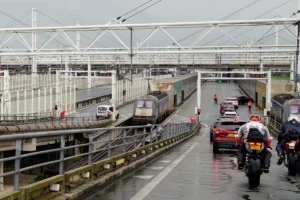
On board & maps of the crossings
Prices and availability for this crossing
Additional Information
When travelling on crossings between Paris and the UK, there are a few important things to keep in mind:
- Bring your passport: Since Brexit, a driver’s licence or ID card is no longer sufficient for travel.
- Download entertainment in advance: On longer night crossings, it’s a good idea to download series or movies beforehand, as Wi-Fi on board can be expensive, and roaming in international waters is costly.
- Foot passengers: Not all ferries accept foot passengers, so check ahead of time.
- Travelling with young kids on a night ferry? We’ve got some helpful tips for travelling with kids here.
- Remember to drive on the right-hand side of the road after disembarking. It can be a bit confusing for the first 10 minutes, but you’ll adjust quickly.
- Worried about getting seasick? In this article, you’ll find some tips to help prevent it.
Luggage & Pets
On most ferries, there are no restrictions on the amount of luggage you can reasonably bring. Pets are allowed, but additional fees apply, and they must stay in designated kennels on board. For some destinations, pets need to meet specific requirements, such as certain vaccinations and a pet passport. You can find country-specific regulations and company policies in this post.