Europe’s three course dinner price map 2026: where is dining out cheapest – and where does your wallet need a little pep talk?
A proper holiday moment is sitting down somewhere lovely, ordering three courses, and pretending you do this every Tuesday. The only problem: in Europe, that same ‘nice dinner for two' can be anything from about £17.35 (€20.00) to over £139.56 (€160.86) in our data. Same idea. Very different bill.
At Ferrygogo, we track the real cost of a holiday in Europe every year, from ferry fares1 and road trip budgets to the everyday costs that shape your trip once you arrive. Dining out is one of the clearest signals of how expensive a destination really is. Combined with transport, accommodation and other daily costs, it helps paint the full picture of what a trip will actually cost.
For many travellers, that price difference doesn’t just affect where you eat, but also how you travel. More and more people combine these kinds of cost insights with ferry trips to France or Spain, where both travel and on-the-ground costs are often more predictable – and sometimes simply better value than flying.
- Cheapest on the map: Kosovo (£17.35 / €20.00)
- Best ‘proper holiday’ value: Portugal, Spain, Greece, Albania, Montenegro
- Most expensive country average: Switzerland (£93.04 / €107.24)
- Priciest cities: Lugano & Zug hit £139.56 / €160.86 for two
- What this measures: a three-course dinner for two, mid-range restaurant, excluding drinks
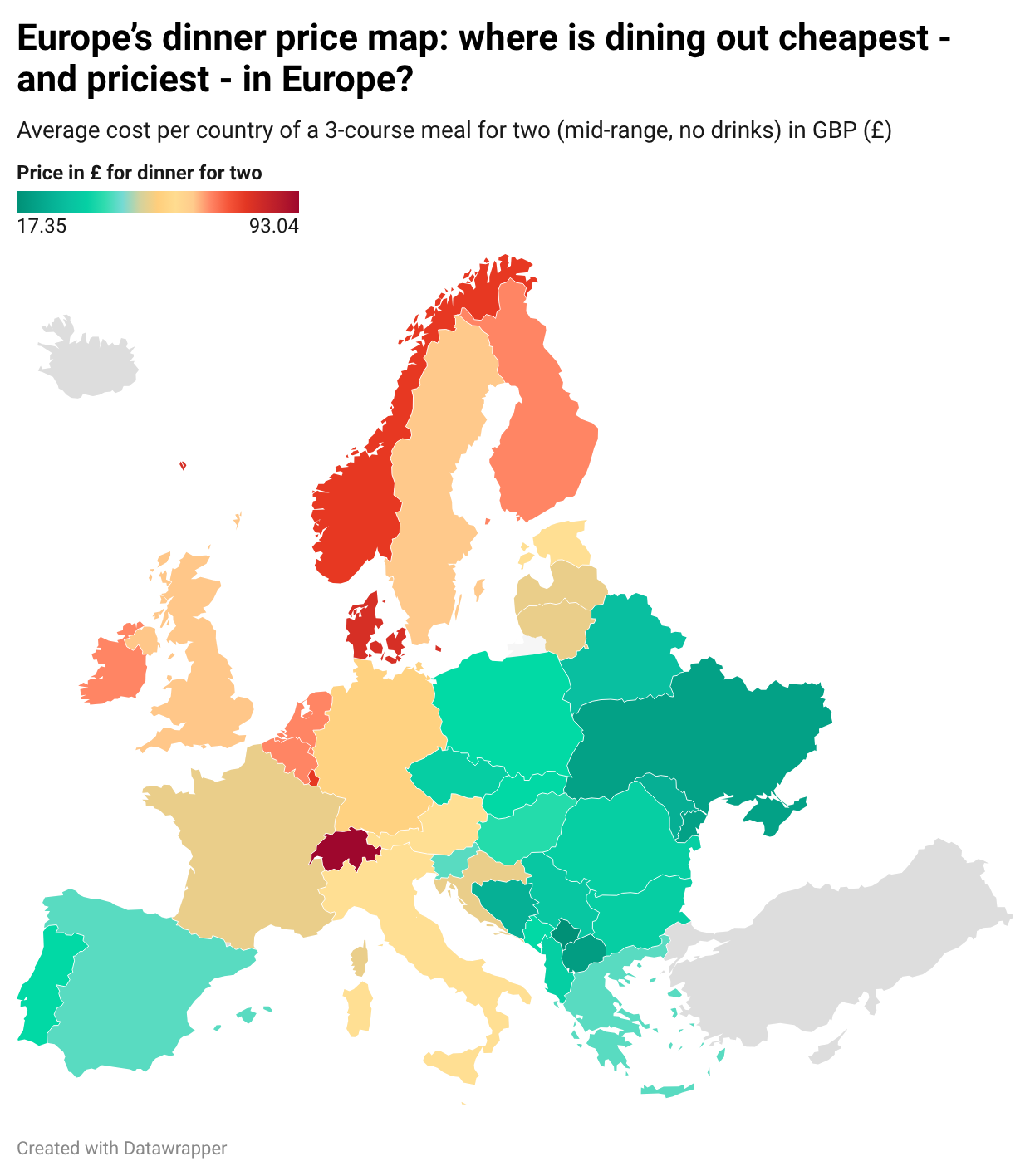
This is our latest research for 2026: the average price of a three-course dinner for two in a mid-range restaurant, excluding drinks. We look at country averages and city examples, so you can compare properly and plan smarter. The map is interactive, hover to see prices (and on mobile, tap a country).
Quick note: for Iceland there was not enough data for a clean nationwide average. Reykjavik is included in the city list, and it still sits firmly in the ‘this better be a very nice meal' bracket.
All country prices in one table
Price of a dinner for two in Europe
Three-course meal for two in a mid-range restaurant (excluding drinks). Prices shown in GBP and EUR.
How we measure: we use the average price for a three-course dinner for two in a mid-range restaurant, excluding drinks. We show both GBP and EUR so it is easy to compare across countries.
The headline winners and losers
If you'd like the ultra-quick version before diving into the tables, here it is.
Top 5 most expensive countries for dinner out
1) Switzerland: £93.04 (€107.24)
2) Denmark: £81.29 (€93.69)
3) Luxembourg: £78.08 (€90.00)
4) Norway: £77.96 (€89.86)
5) Netherlands / Ireland / Finland / Belgium: £69.41 (€80.00)
Cheapest countries for dinner out (price-only)
If you’re looking purely at the dinner bill (three courses for two, mid-range, no drinks), these are the lowest averages in our 2026 dataset once we exclude destinations where travel conditions can change quickly. Quick reality check: ‘cheapest dinner' doesn’t automatically mean ‘best holiday' – it’s simply the lowest dining-out price level.
- Kosovo: £17.35 (€20.00)
- North Macedonia: £21.15 (€24.38)
- Moldova: £26.30 (€30.32)
- Bosnia & Herzegovina: £26.68 (€30.75)
- Serbia: £33.26 (€38.34)
Note: Prices are one thing; travel suitability is another. Always check the latest official travel advice and local conditions before you book, especially where circumstances can change quickly.
Best value for a proper holiday (great trips, still sensible dinner prices)
If you want the sweet spot – proper holiday vibes plus dining-out prices that don’t sting – these are the stand-outs. They’re not always the absolute cheapest on paper, but they’re the ones most people actually want to go to (and feel like they’re getting a lot for their money).
- Portugal (£39.04 / €45.00): beaches, city breaks, wine, and a very friendly ‘treat-yourself' budget.
- Spain (£43.38 / €50.00): proper foodie country, loads of choice, and excellent value once you’re there.
- Greece (£43.38 / €50.00): islands + tavernas = strong holiday happiness per pound.
- Albania (£36.00 / €41.49): the Adriatic ‘wait, why is this so good?' pick: beaches, mountains, and still great value.
- Montenegro (£39.04 / €45.00): dramatic coastline, lovely old towns, and prices that feel refreshingly pre-2020s.
These destinations also work particularly well for travelling to Spain and Portugal without the plane, where combining ferry travel with a road trip can often be both more affordable and more flexible than flying directly.
Bonus (good value, more ‘classic mainstream'): France (£52.06 / €60.00) is not bargain-basement, but it’s a strong all-rounder for variety and ease, and it often feels good value once you compare it with the UK/Benelux/Scandinavia price bracket.
The most expensive countries for dinner out: Switzerland and Denmark top the list
No huge surprises here. The priciest countries for dining out still cluster in North-West Europe, with Switzerland comfortably wearing the crown.
Top tier: Switzerland comes in at £93.04 (€107.24) for a three-course dinner for two, followed by Denmark at £81.29 (€93.69), Luxembourg at £78.08 (€90.00), and Norway at £77.96 (€89.86).
Then you hit the next bracket where plenty of us live day to day, but it starts to look expensive the moment you compare it with classic holiday favourites. The Netherlands, Ireland, Finland, and Belgium all sit at £69.41 (€80.00). The UK follows at £65.00 (€74.92), and Sweden at £64.80 (€74.69).
A small eyebrow-raiser: Ireland lands higher than the UK average in this dataset. Great craic, slightly less great when the bill arrives.
Where dinner is still great value
At the other end of the scale, you can still find places where dining out feels like a holiday perk again. In a few countries, the ‘dinner for two' figure works out to under £20 per person, and that is not something you see every day in 2026.
The very bottom of the table starts with Kosovo at £17.35 (€20.00) for two, followed by North Macedonia at £21.15 (€24.38), then Moldova at £26.30 (€30.32) and Bosnia & Herzegovina at £26.68 (€30.75). In other words: in a few places, eating out still feels like a genuine holiday perk.
And there’s a whole next tier where dinner is still very friendly: Bulgaria at £35.49 (€40.91), the Czech Republic at £35.73 (€41.18), Romania at £35.80 (€41.26), and Albania at £36.00 (€41.49). Plenty of ‘yes, go on then' room left for dessert.
France, Spain, and Portugal: brilliant value for real holidays
If you want destinations that are both popular and genuinely good value, three countries jump out as the sweet spot between holiday quality and dining-out prices.
Portugal sits at £39.04 (€45.00) for a three-course dinner for two, Spain at £43.38 (€50.00), and France at £52.06 (€60.00). None of these are ‘ultra-cheap on paper' like some Balkan averages, but for mainstream holiday planning, they are excellent value.
For Ferrygogo travellers, this matters. France is the classic ferry win for weekends, road trips, and family holidays via UK to France ferry routes. Spain remains a strong-value foodie destination, with excellent ferry connections to northern Spain. Portugal is still very doable too, especially if you travel via northern Spain and turn the journey into a road trip rather than a sprint.
So what do we conclude from the country numbers?
If you are planning around these price differences, it is worth thinking about how you get there as much as where you go. Routes that combine driving and ferries often give you more control over costs compared to peak-season flights.
Three takeaways stand out for 2026:
1) North-West Europe is still the expensive corner. Switzerland at £93.04 (€107.24) sits miles ahead, while Scandinavia stays high, with Denmark at £81.29 (€93.69) and Norway at £77.96 (€89.86). The Netherlands, Belgium, Finland, and Ireland also sit in the higher band at £69.41 (€80.00).
2) Southern Europe gives you more ‘holiday lifestyle' per pound. Portugal at £39.04 (€45.00) and Spain at £43.38 (€50.00) are strong-value destinations for dining out, while France at £52.06 (€60.00) is a very solid mid-priced option with a huge variety.
3) Central and South-East Europe still deliver serious value. Romania at £35.80 (€41.26), Bulgaria at £35.49 (€40.91), Albania at £36.00 (€41.49), and Serbia at £33.26 (€38.34) remain excellent choices. Even cheaper are Bosnia & Herzegovina at £26.68 (€30.75) and North Macedonia at £21.15 (€24.38).
If you are taking the ferry from the UK to France or northern Spain, your dining budget can genuinely stretch further than at home. In the UK the country average is £65.00 (€74.92). Spain sits at £43.38 (€50.00) and Portugal at £39.04 (€45.00). That gap adds up quickly if you are eating out a few times during the trip. With Brittany Ferries you can sail easily to France & Northern Spain.
Europe’s most expensive cities for dinner out
Country averages are useful, but cities tell the real story for travellers. Capitals and major tourist hubs are often pricier than the national headline. These are the places where dining out gets expensive fast.
The priciest city list is dominated by Switzerland and Scandinavia, plus a few headline capitals. Switzerland’s top cities are in a league of their own, with dinner for two hitting £139.56 (€160.86) in Lugano and Zug. Zurich sits at £111.65 (€128.69), and Geneva at £107.00 (€123.33). Oslo is also up there at £103.46 (€119.24), and Copenhagen at £92.90 (€107.07).
Not saying you should avoid them. Just saying your ‘three courses' might become ‘two courses and a very meaningful bread basket'.
Cities where you can eat out without breaking the bank
This is the list that makes holiday planners smile. Plenty of places across Southern, Central and South-East Europe still offer great dining-out value, including several destinations that are genuinely brilliant for a few days away.
Great value holiday picks: Skopje comes in at £25.38 (€29.25) and Sarajevo at £28.90 (€33.31), which is hard to beat for a city break. Poland is also a strong ‘outsider' for value, with Krakow and Gdansk both at £41.20 (€47.49). Portugal stays excellent for mainstream travel, with Lisbon and Porto at £43.38 (€50.00), and Spain keeps it flexible with places like Seville at £43.38 (€50.00).
If dining out is a big part of your holiday (and let’s be honest, it usually is), your 2026 pattern is clear. For the best ‘foodie holiday per pound', Southern Europe is the sweet spot, with Portugal at £39.04 (€45.00), Spain at £43.38 (€50.00) and France at £52.06 (€60.00) offering excellent value, especially if you are travelling by ferry routes to France or to northern Spain and turning the journey into a road trip.
If you want standout city-break value, places like Skopje at £25.38 (€29.25), Sarajevo at £28.90 (€33.31) and Krakow or Gdansk at £41.20 (€47.49) are hard to beat. And if your plans include Switzerland or Scandinavia, it’s not a ‘don’t go', it’s a ‘go clever' – pick a couple of big dinners, mix in lunch menus and markets, and your wallet will forgive you by the time you are back on the ferry.
Data sources
All the underlying data for this research can be found in this Google Sheet and on Numbeo.2 The figures reflect the average price of a three-course dinner for two in a mid-range restaurant, excluding drinks, data was pulled mid January 2026.
- Price research: ferry fares for the summer of 2026 ↩︎
- https://www.numbeo.com/cost-of-living/ ↩︎
A couple of sensible caveats: prices are crowd-sourced, so coverage and price levels can vary by country and city (popular tourist spots may skew higher; smaller towns may skew lower). Treat this as a useful benchmark for planning rather than an exact quote for a specific restaurant on a specific night.



Jan Willem van Tilburg is co-founder of FerryGoGo and focuses on ferry market research, editorial strategy and practical travel content. His work covers ferry fares, route comparisons and first-hand travel guides based on real crossings. Jan Willem has sailed routes including Saint-Malo to Portsmouth, Portsmouth to Cherbourg, Newcastle to Amsterdam and Harwich to Hook of Holland himself, helping keep FerryGoGo’s guides grounded in real traveller experience.