

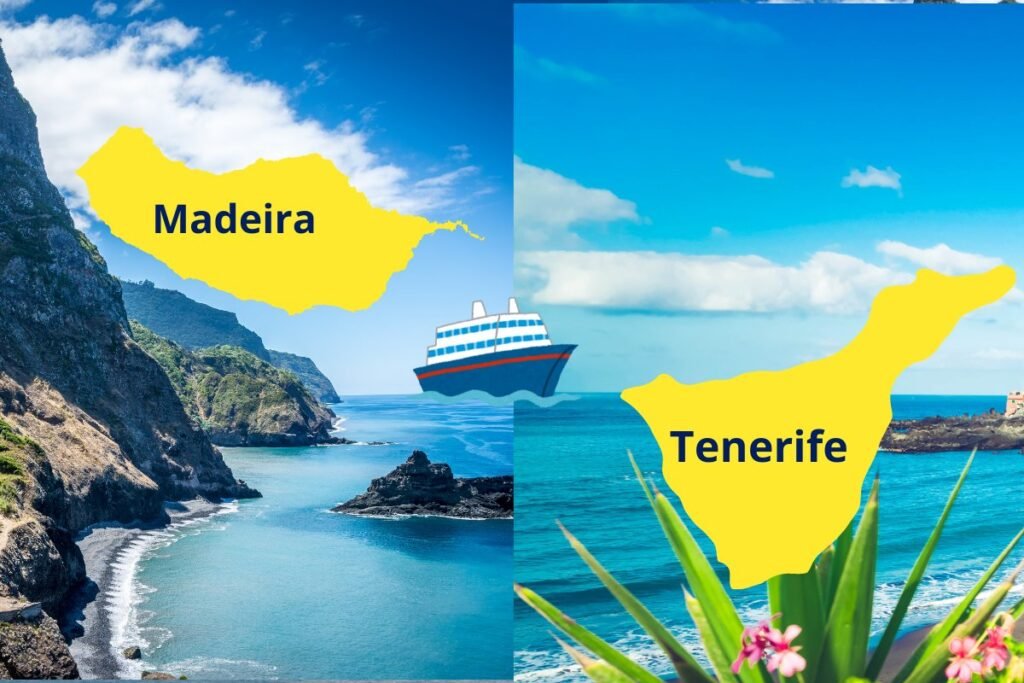
At the moment, there is no regular passenger ferry from mainland Portugal or the Canary Islands to Madeira. The old ferry links to Funchal have disappeared, and for most travellers Madeira is now reached by air rather than by sea.
Updated May 2026: there is still no regular passenger ferry from mainland Portugal or the Canary Islands to Madeira. The main ferry that does operate is the domestic Funchal to Porto Santo crossing, run by Porto Santo Line. Direct Ferries also currently lists no Gran Canaria to Madeira sailings.
Current status: there is no regular passenger ferry from mainland Portugal or the Canary Islands to Madeira. The main ferry that still runs is the domestic Funchal to Porto Santo crossing.
That can be confusing, because Madeira does still have ferry activity. There is a domestic ferry between Funchal and Porto Santo, and cargo ships continue to serve the island. But if you are looking for a normal car ferry from Portugal, Tenerife, Gran Canaria or the wider Canary Islands to Madeira, there is currently no bookable passenger route.
This is a shame, because a ferry to Madeira would be useful for travellers who want to bring a car, campervan, motorbike, bicycle or pet. It would also give Madeira a slower but more flexible alternative to flying. For now, though, the island remains one of those places where the ferry map looks emptier than many travellers expect.
What happened to the Madeira ferry?
In the past, there were ferry connections linking Madeira with mainland Portugal and the Canary Islands. The best-known route connected Portimão and Funchal, while there have also been services involving Funchal and ports such as Las Palmas in Gran Canaria.
Those services were never as established as the big ferry corridors you see elsewhere in Europe. Madeira sits far out in the Atlantic, so crossings are long, ships are expensive to run, and air travel is much faster. A flight from mainland Portugal to Madeira takes around two hours, while a ferry crossing would usually mean a full day or more at sea.
That does not mean the idea has disappeared completely. There are still periodic calls in Madeira for a mainland ferry to return, especially because a ferry would help residents, vehicles and freight move more freely between Madeira and the continent. But calls for a ferry are not the same as an active route. Until there is a confirmed operator, timetable and booking system, travellers should assume there is no regular mainland ferry to Madeira.
Can you take a ferry from Portugal to Madeira?
No, not as a regular passenger ferry at the moment. The old Portimão to Funchal ferry is not operating as a standard bookable route for tourists.
This is often the route people search for first, because it would make the most sense on a map: drive to southern Portugal, board the ferry in Portimão, and arrive in Madeira with your own vehicle. Unfortunately, that option is not currently available as a normal ferry service.
Can you take a ferry from the Canary Islands to Madeira?
No, there is currently no regular ferry from the Canary Islands to Madeira either. That means there is no normal passenger ferry from Gran Canaria or Tenerife to Funchal.
This feels like a route that should exist, especially when you look at Madeira and the Canary Islands on a map. But the distance is still significant, demand is seasonal, and ferry operators need enough passengers, vehicles and freight to make a long Atlantic route viable.
The ferry that does still run: Funchal to Porto Santo
The important exception is the domestic ferry between Funchal on Madeira and Porto Santo. This route is operated by Porto Santo Line with the ferry Lobo Marinho and takes around 2 hours and 30 minutes.
So if you are already on Madeira and want to visit Porto Santo, the ferry is a realistic and useful option. It is also a proper passenger ferry, with space for travellers and vehicles. But it does not solve the bigger question of how to get to Madeira from mainland Europe by ferry.
What about cargo ships to Madeira?
There are cargo services between mainland Portugal and Madeira. GS Lines, for example, operates maritime cargo services to Madeira, including vessels serving the island from the Portuguese mainland.
Sometimes travellers mention cargo-ship cabins as a possible alternative. This can be interesting if you are moving to Madeira or need to ship a vehicle, but it is not the same as booking a normal ferry ticket. Passenger availability, rules, baggage limits, insurance requirements and schedules can change, and you normally need to contact the shipping company or an agent directly.
In short: cargo ships may be an option in specific cases, but they are not a simple replacement for a regular ferry to Madeira.
Why did air travel take over?
Flying is simply much easier for most Madeira travellers. Flights are faster, more frequent and often cheaper than a long-distance ferry would be. Airlines also offer more flexible departure days, while a ferry from mainland Portugal or the Canary Islands would probably run only a few times per week at best.
For a ferry operator, the challenge is different. A long route needs a suitable ship, enough passenger demand, enough vehicle demand, freight support, port agreements and often political or regional backing. Without that mix, routes like Madeira to mainland Portugal are difficult to keep profitable.
This is exactly the kind of route many travellers expect to exist when they look at the map, but the economics of a long Atlantic crossing are much harder than the geography suggests.
From a traveller’s point of view, that is frustrating. A ferry would make Madeira easier for people travelling with pets, cars, campers or larger luggage. It could also offer a lower-stress travel option and, depending on the ship and load factors, potentially a different carbon footprint profile than flying. But convenience has clearly pushed the market towards air travel.
Will the Madeira ferry return?
It is possible, but we would be cautious. The return of a mainland ferry is discussed from time to time in Madeira, and there is clear local interest in having a sea link with the continent again. The strongest argument is not only tourism, but also mobility for residents, cars, freight and the regional economy.
Still, a route is only real for travellers once it has a confirmed operator, sailing schedule, fares and a booking system. Until then, the Madeira ferry remains an idea people would like to see return, not a service you can rely on for your trip.
Conclusion: no normal ferry to Madeira for now
For now, there is no regular passenger ferry from mainland Portugal or the Canary Islands to Madeira. The old ferry links have disappeared, and most travellers will need to fly to Funchal.
The one clear ferry option is the domestic crossing between Funchal and Porto Santo. Cargo ships may help in specific situations, especially for freight or vehicle transport, but they are not a straightforward tourist ferry.
We would like to see a proper Madeira ferry return one day. It would be genuinely useful, especially for people travelling with a vehicle, dog, campervan or more luggage than a flight allows. But at the moment, Madeira remains a destination where the sea routes are much more limited than the map suggests.
Get our latest ferry guides, route updates and travel tips in your Google feed. Add FerryGoGo as a preferred source in Google, and follow us in Discover when Google shows the option.








As of December 2025, GSLines no longer accepts passengers