Jan Willem van Tilburg
France remains the destination UK ferry travellers are most likely to sail to in the next 12 months, according to new FerryGoGo research. The survey also suggests that for France, the real rival is LeShuttle rather than flying.
British ferry travellers may dream of a direct route back to Norway, but when it comes to their next actual ferry trip, France still comes first.
That is one of the clearest findings from the FerryGoGo UK Ferry Travel Survey 2026, completed by 197 ferry-interested UK travellers in May 2026. The research separates two types of demand that are easy to mix up: the routes people would love to see launched or brought back, and the destinations they are actually likely to travel to by ferry in the next 12 months.
The dream route points north. A UK to Norway route, such as Newcastle to Bergen or Stavanger, was the single most requested launch, chosen by 56.9% of respondents (112 of 197). The actual travel intent points closer to home. Among the 192 respondents who named a likely ferry destination, France came top.
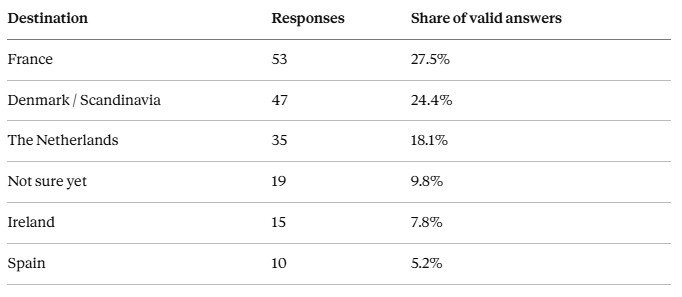
Source: FerryGoGo UK Ferry Travel Survey 2026. Destination intent n=192 valid answers. France-specific findings in this article are based on 53 respondents and should be read as indicative of ferry-interested travellers, not as a national poll.
France is the ferry trip people actually plan
The appetite for Norway, Sweden and Denmark is mostly about routes that no longer exist, or that do not exist from the UK in the way travellers would like. Think Newcastle to Norway, Harwich to Esbjerg, or a revived Scotland-to-mainland-Europe crossing.
France is different. It is already part of how UK travellers reach Europe. It is not a nostalgic ferry wish. It is everyday travel behaviour: family holidays, weekends away, camping trips, second-home travel, dog-friendly holidays and road trips where the car is part of the plan.
That makes the ferry to France feel very different from a dream route to Scandinavia. It is less about ‘wouldn’t it be nice if this existed?’ and more about ‘which crossing actually works best for my trip?’ For many UK travellers, the ferry is not just a way over the Channel. It is the first stage of a self-drive holiday.
‘Norway is the route people dream about, but France is the trip they actually plan. And for France, the real choice is often not plane versus ferry. It is ferry versus tunnel.’
JW van Tilburg, co-founder, FerryGoGo
For France, the rival is LeShuttle, not the plane
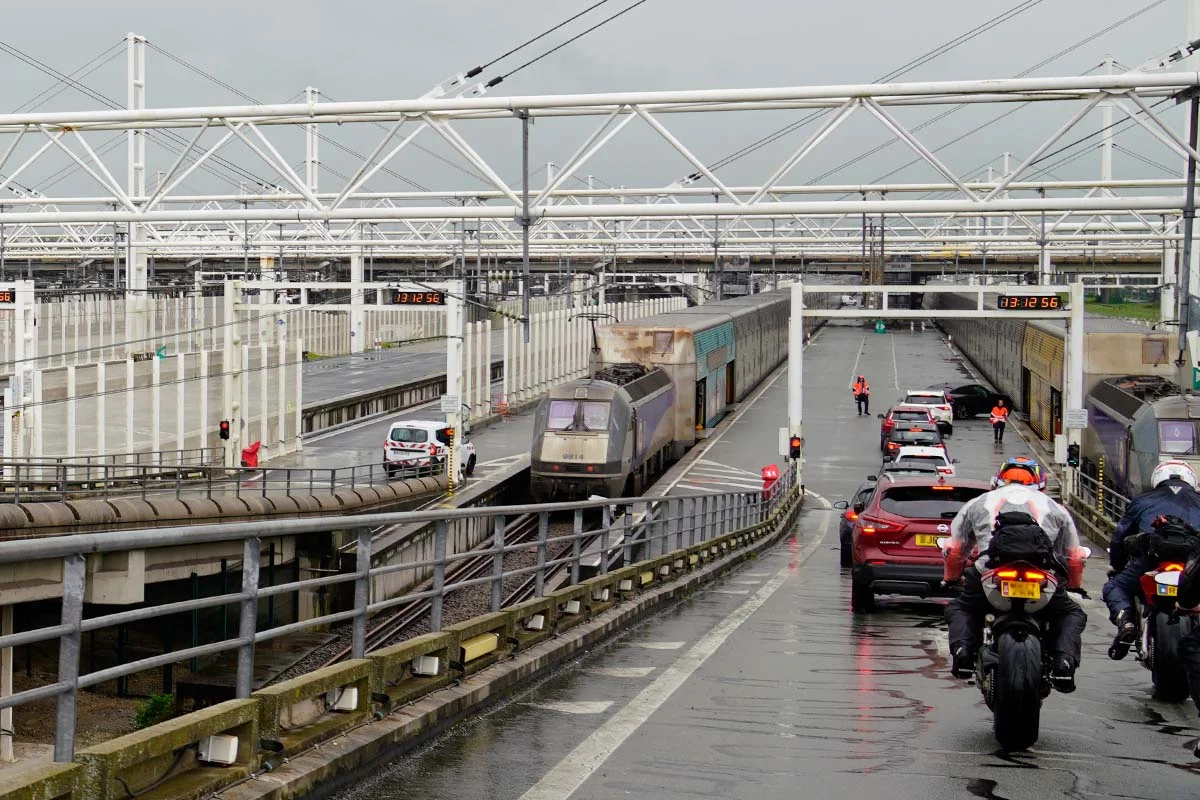
The UK ferry story is often told as ferry versus flying. For France, that framing does not quite work. Asked what they would most likely compare the ferry with, France-bound respondents named the tunnel first, not the airport.
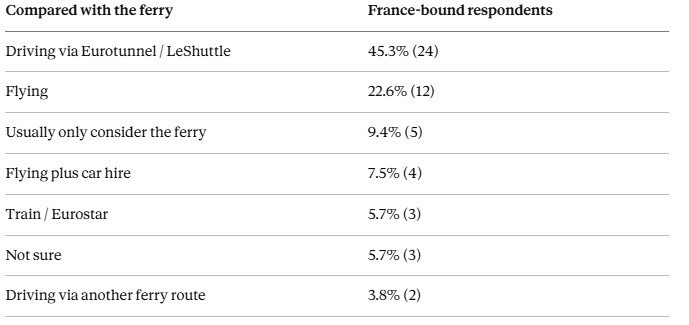
Source: FerryGoGo UK Ferry Travel Survey 2026, France-bound respondents (n=53).
This changes the whole story. For Spain, Scandinavia or longer European trips, flying plus car hire may be the obvious alternative. For France, the question is usually much more specific: ferry or tunnel?
Which is cheaper? Which departure port is easier to reach? Which option cuts the drive in France? Which works better with children, dogs, bikes or a campervan? And is it better to arrive in Calais, or does a longer sailing into Normandy or Brittany make the whole journey easier?
A telling detail sits underneath this. France-bound travellers rated ferry comfort at 7.7 out of 10, while flying scored 5.7. That is a gap, but not a huge one. For France, comfort helps, but it is probably not the main reason people choose the ferry. The car, the flexibility and the total journey matter more. Across the whole survey, the comfort gap is far wider: 8.0 for the ferry against 5.0 for flying, although that is driven by longer routes.
France-bound travellers are bringing vehicles
The strongest France-specific signal in the survey is the car. Among the 53 respondents who named France as their likely ferry destination, 35 usually travel by ferry with a car, which is 66%. Another 7 travel with a campervan or motorhome. A smaller number travel by motorcycle, as foot passengers or by bicycle.
| Travel style | Respondents (of 53) |
|---|---|
| With a car | 35 |
| With a campervan or motorhome | 7 |
| As a foot passenger | 4 |
| With a motorcycle | 3 |
| With a bicycle | 2 |
So the overwhelming majority are not thinking like air passengers. They are road-trippers. For them, the ferry is not just competing on ticket price or crossing time. It is carrying the whole holiday: the family car, the luggage, the dog, the bikes, the roof box, the camping gear, and the freedom to drive on from the port without waiting at a rental desk.
That is why France stays strong. A ferry to France, whether to Calais, Dunkirk, Dieppe, Caen, Cherbourg, Le Havre, Roscoff or Saint-Malo, does not just deliver passengers. It delivers people with their own vehicle, ready to move. For Normandy, Brittany and Hauts-de-France, that is the real message: UK ferry travellers do not just arrive in France. They arrive ready to explore it.
Price matters, but the whole journey matters more
France-bound travellers are practical. The single biggest booking factor was lowest price, chosen by 43.4%. But this was a question where travellers could choose more than one factor, and the rest of the list shows they are not only looking for the cheapest crossing.
| Booking factor | France-bound respondents |
|---|---|
| Lowest price | 43.4% |
| Comfortable cabins | 24.5% |
| Good food and facilities on board | 20.8% |
| Best departure time | 18.9% |
| Arriving close to the final destination | 15.1% |
| Easy port access | 15.1% |
That mix matters because the shortest crossing is not always the best route. A quick hop to Calais or Dunkirk suits plenty of trips. But for other journeys, a longer sailing into Normandy or Brittany can cut the drive on the French side and make the trip feel calmer. Sometimes the best route is not the fastest sea crossing. It is the one that makes the whole journey easier.
That is the bit travellers need help with. Not just ‘what is the cheapest ferry?’, but ‘which crossing actually makes sense for where I am going?’
Brittany Ferries leads on experience
Asked which ferry company gave them the best experience from the UK, France-bound respondents named Brittany Ferries most often (34%), ahead of DFDS (20.8%), with P&O Ferries and ‘no clear favourite’ tied at 17% each.
That is not a massive surprise, given Brittany Ferries’ role on the longer western routes to France and Spain. But it is still useful. Among travellers thinking about France, a sizeable group values the crossing itself: cabins, food, lounges, pet facilities, departure times and overnight options. That is where the Normandy and Brittany routes can compete: not by pretending they are the shortest way to France, but by being the most sensible route for the right journey.
This is a repeat, route-choice market
France-bound respondents are not just hypothetical ferry travellers. Of those who answered the frequency question, 42.3% travel by ferry several times a year and 23.1% about once a year, which means roughly two thirds travel by ferry at least annually. Another 19.2% used to travel by ferry, but not recently.
The survey also suggests that UK ferry travellers are not simply looking for a list of crossings. They want help choosing the route that makes the most sense for the whole trip. Among France-bound respondents, 25.5% wanted clearer route comparisons, 25.5% wanted easier booking links and route options, 19.6% wanted more comparisons between ferry, train and flying, and 17.6% wanted more ferry price examples.
For France, that matters because the best crossing is not always the shortest one. A quick Channel crossing may work for some trips, while a longer sailing to Normandy or Brittany can reduce the drive in France and make the journey calmer, especially for families, dog owners, campervan travellers and self-drive holidays.
What the survey says about ferry travel to France
The survey suggests that France remains one of the strongest ferry markets for UK travellers, not because it is a dream route, but because it is already part of how many people travel to Europe.
For France, the ferry is mainly a self-drive choice. Travellers are not just crossing the Channel; they are bringing their car, campervan, bikes, pets and luggage with them. That also explains why the main comparison is not always flying, but LeShuttle and the total journey by road.
The opportunity for French ports is therefore not only about offering the shortest crossing. For some travellers, a longer sailing to Normandy or Brittany can make the whole journey easier by reducing the drive after arrival. That is where route choice, port location and clear comparisons become important.
The full results are available in the FerryGoGo UK Ferry Travel Survey 2026.
Methodology
The FerryGoGo UK Ferry Travel Survey 2026 was completed by 197 ferry-interested UK travellers between 4 and 31 May 2026. It was a self-selected survey of FerryGoGo readers and ferry-interested travellers, not a representative poll of the whole UK population. Not every respondent answered every question, so percentages are based on valid responses to each question, and several questions allowed more than one answer. France-specific findings are based on 53 respondents.
Related FerryGoGo research
- UK Ferry Travel Survey 2026: missing routes matter more than price
- The UK wants its Norway ferry back
- Ferry beats flying for comfort, and it is not even close
Get our latest ferry guides, route updates and travel tips in your Google feed. Add FerryGoGo as a preferred source in Google, and follow us in Discover when Google shows the option.