✓ Plan and book your perfect crossing – simple, fast, and reliable | Explore Ferrygogo worldwide 🌐

Ferry to Germany from the UK: compare the best routes

There is no direct UK-Germany ferry. Compare routes via the Netherlands and France to find the best crossing for your complete journey.

What is the best ferry route from the UK to Germany?

For most journeys to Germany, a ferry to the Netherlands is the most practical choice. Harwich-Hook of Holland, Hull-Rotterdam and Newcastle-IJmuiden all bring you considerably closer to Germany than a ferry to western France.

The best crossing depends on two parts of the journey: where you start in Britain and where you are going in Germany. A longer overnight crossing can reduce driving and give you a proper night’s rest, while Dover or LeShuttle offers more departure flexibility but leaves a longer drive across France and Belgium.

Route Usually suits Main advantage Keep in mind
Harwich-Hook of Holland London, East Anglia and southern England Direct arrival in the Netherlands with good onward access towards western Germany An overnight cabin adds cost but replaces a night in a hotel
Hull-Rotterdam Yorkshire, the Midlands and northern England Overnight crossing with relatively little driving after arrival Rotterdam Europoort is outside the city, which is useful by car but less convenient without one
Newcastle-IJmuiden North East England and Scotland Avoids a long drive south through Britain It is the longest of the three UK-Netherlands crossings
Dover-Calais or Dover-Dunkirk Kent, London, South East England and flexible road trips Frequent crossings and a short time at sea The drive from northern France to Germany is considerably longer
LeShuttle Drivers prioritising the fastest Channel crossing Very short crossing between Folkestone and Calais It is a car train, not a ferry, and check-in and border time still count

Our overall verdict: choose the Netherlands for the most balanced journey to western, northern and central Germany. Choose Dover or LeShuttle when you start in South East England, need maximum flexibility or are travelling towards south-western Germany.

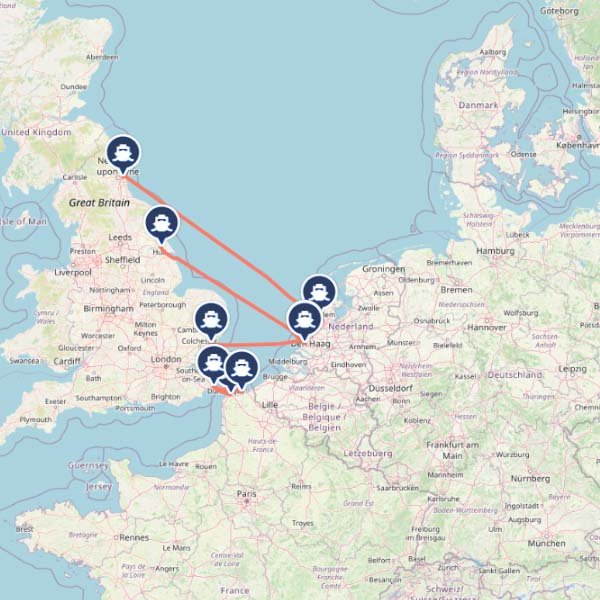
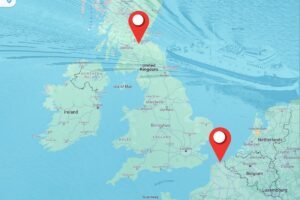
Map: ferry routes to Germany from the UK

Popular

Dover Calais P&O

DFDS, Irish Ferries, P&O
26 miles
1h 30 mins.
Up to 35 times per day
No
Car ferry
From: £80.00
Popular

Hull-Rotterdam

P&O
237 miles
11h 30 mins.
Once per day
From: £250.00
Popular
stenaline ferry

Harwich Hook of Holland

Stena Line
125 miles
6h 30 mins.
Up to 2 times per day
From: £210.00
Popular
dfds seaways ferry

Newcastle-Amsterdam

DFDS
368 miles
17 hours
Once per day
From: £175.00

Dover-Dunkirk

DFDS
47 miles
2 Hours
Up to 8 times per day
No
Car ferry
From: £81.00

Choose your crossing by where you start in the UK

From London, East Anglia and the South East

Harwich-Hook of Holland is often the most balanced ferry route. You sail directly to the Dutch coast and can continue towards Germany without first driving across northern France and Belgium.

From Kent and parts of South East England, Dover-Calais, Dover-Dunkirk and LeShuttle remain competitive. They are especially useful if departure flexibility matters more than reducing the continental drive.

From the Midlands and Yorkshire

Hull-Rotterdam is usually the first route to compare. The sailing takes place overnight, so much of the distance is covered while you sleep. After arriving at Rotterdam Europoort, you are already on the correct side of the Netherlands for the drive towards Germany.

Driving south to Dover may produce a shorter crossing, but it can add a substantial UK drive before you have even reached the continent.

From North East England and Scotland

Newcastle-IJmuiden can make the most sense despite having the longest crossing. The real advantage is avoiding the drive from northern Britain to Hull, Harwich or Dover.

IJmuiden is west of Amsterdam, so it is not the closest Dutch port to Germany. However, the complete journey can still be calmer and more efficient when Newcastle is much closer to home.

From western and south-western Britain

A departure from Portsmouth or another south-coast port can reduce the British part of the journey, but most western France arrivals are not particularly well placed for Germany. Compare the complete driving route carefully before choosing a Brittany Ferries crossing purely because the departure port is closer.

For many German destinations, travelling east towards Harwich or Dover will still produce the more logical overall route. See our UK-France ferry comparison if you want to assess the southern alternatives.

Which ferry is best for your destination in Germany?

German destination Routes to compare first Why
Düsseldorf, Cologne and the Ruhr Harwich-Hook of Holland or Hull-Rotterdam The Netherlands gives the most direct continental approach to western Germany
Bremen, Hamburg and northern Germany Hull-Rotterdam or Harwich-Hook of Holland Both avoid the detour through northern France and Belgium
Berlin and eastern Germany A Netherlands crossing, chosen according to your UK starting point There is still a long onward drive, so an overnight crossing can be more useful than a short Channel hop
Frankfurt and central Germany Harwich-Hook of Holland, Hull-Rotterdam or Dover-Calais The best option depends more heavily on where your UK journey begins
Aachen, Saarland and south-western Germany Dover-Calais, Dover-Dunkirk or LeShuttle The route through Belgium can be competitive for Germany’s western and south-western edge
Stuttgart, Munich and southern Germany Compare the Netherlands with Dover or LeShuttle All options leave a substantial drive, so sleep, departure location and total travel time matter more than ferry duration alone

Driving times can change considerably with congestion around Rotterdam, Antwerp, Brussels and the Ruhr. Check the complete route for your actual travel date rather than comparing ferry duration alone.

5h 30 mins.
106 miles
Up to 5 times per week
From: £77.00
6 Hours, 8 hours
84 miles
Up to 3 times per week
From: £99.00
4h 30 mins.
77 miles
Up to 1 time per day
From: £121.00
These routes are tested, not just listed. We have travelled all three direct UK-Netherlands ferry routes ourselves: Harwich-Hook of Holland with Stena Line, Hull-Rotterdam with P&O Ferries and Newcastle-IJmuiden with DFDS. We have also tested the main Dover-Calais ferry operators and LeShuttle.

What our crossings taught us

Harwich-Hook of Holland

We have made this crossing both as a vehicle journey and as part of Stena Line’s Rail & Sail journey from London. The overnight sailing worked particularly well when we wanted the journey to feel less rushed. A cabin, space for the children and the ability to sleep while travelling changed the value calculation considerably.

Read our overnight Harwich-Hook of Holland experience

Hull-Rotterdam

This is a particularly useful overnight option from northern and central England. Our practical lesson is to prepare a separate overnight bag before boarding. Take everything you need from the car and find your cabin first, as the vehicle deck is not normally accessible during the crossing.

Read our Hull-Rotterdam experience

Newcastle-IJmuiden

The sailing is long, but that does not automatically make it the slowest overall choice. From North East England or Scotland, avoiding a long drive south can outweigh the additional hours at sea. It works best when you treat the crossing as overnight travel rather than lost time.

Read our Newcastle-IJmuiden experience

Is a ferry or LeShuttle better for Germany?

LeShuttle is the fastest way to cross the Channel with a car, but the shortest crossing does not always produce the easiest journey to Germany. You still need to allow for check-in, border controls and the drive through France and Belgium.

In our own Channel comparison, LeShuttle was the obvious time-led option. The ferry provided a more useful break during a longer road journey because we could leave the car, walk around, eat and get some fresh air.

  • Choose LeShuttle if crossing speed, frequency and remaining with your vehicle are the priorities.
  • Choose Dover-Calais or Dover-Dunkirk if you want a short crossing that also provides a break from driving.
  • Choose an overnight Netherlands ferry if reducing driving and arriving after a night’s rest matters more than the sailing duration.

Plan the complete UK-Germany journey

Compare total journey time

Do not compare routes using sailing time alone. Include the drive to the British port, recommended check-in time, the crossing, disembarkation and the onward drive from the arrival port.

Decide whether an overnight cabin replaces a hotel

Harwich-Hook of Holland, Hull-Rotterdam and Newcastle-IJmuiden are not simply longer alternatives to Dover. An overnight sailing can combine transport and accommodation. This can be especially valuable for families or drivers who would otherwise need a hotel stop.

Prepare an overnight bag

When travelling with a car, pack passports, medication, chargers, toiletries, children’s essentials and clothes for the next morning in one small bag. Do not assume you can return to the vehicle deck during the crossing.

Check environmental and vehicle requirements

Some German cities have environmental zones, and vehicle requirements can differ from those in the UK. Check the rules for your destination and any countries you drive through shortly before departure.

Allow for busy road corridors

Routes from Dutch ports can encounter congestion around Rotterdam and the Ruhr. Channel routes can be delayed around Calais, Antwerp and Brussels. A route that appears slightly shorter on paper may not remain faster during peak travel periods.

Travelling without a car

Harwich-Hook of Holland is the strongest ferry option to investigate because Harwich has a rail connection and Hook of Holland connects with the Dutch public transport network. However, travelling onward to Germany normally requires separate rail planning rather than one simple through ferry ticket.

Ferry maps

Compare ferry prices for the journey to Germany

There is no single UK-Germany ferry ticket, so compare the crossing that brings you to the Netherlands or France. Prices vary according to the route, travel date, vehicle, passenger numbers, cabin type and ticket flexibility.

For a fair comparison, include more than the ferry fare. An overnight Netherlands ferry may cost more than a short Channel crossing, but it can reduce fuel, motorway driving and the need for a hotel. Dover or LeShuttle can be more economical when the departure port is close to home and several people are sharing the car.

Use the booking module to check availability for your dates, but make the route decision first. Start with Harwich-Hook of Holland, Hull-Rotterdam or Newcastle-IJmuiden for most German destinations. Compare Dover-Calais, Dover-Dunkirk and LeShuttle when travelling from southern England or towards south-western Germany.

Frequently asked questions

Is there a direct ferry from the UK to Germany?

No. There is currently no direct scheduled passenger and car ferry between the UK and Germany. Most travellers sail to the Netherlands or northern France and continue by road or rail.

Which Dutch ferry port is closest to Germany?

Hook of Holland and Rotterdam are generally the most useful arrivals for driving towards Germany. IJmuiden is farther north-west, but Newcastle-IJmuiden can still be the best overall route for travellers starting in North East England or Scotland.

What is the quickest route from the UK to Germany?

That depends on the starting point and German destination. LeShuttle provides the shortest Channel crossing, but a Netherlands ferry can reduce the onward drive. Compare door-to-door time rather than crossing time alone.

What is the best ferry to Germany from London?

Harwich-Hook of Holland is usually the first ferry to compare from London, particularly for western, northern and central Germany. Dover or LeShuttle may be faster for some journeys towards Aachen and south-western Germany.

Which route is best from northern England?

Hull-Rotterdam is usually the strongest option from Yorkshire, the Midlands and much of northern England. Newcastle-IJmuiden becomes more attractive from North East England and Scotland.

Can I travel from the UK to Germany by ferry without a car?

Yes, but the journey requires more planning. Harwich-Hook of Holland works particularly well with rail at both ends. You will normally need separate ferry and onward train arrangements, so check connections before booking.

2 Comments
  1. I am planning a trip to Europe. Why was ferry boat service from the UK to Germany stopped? Was it economic? political?

    • Hi Larry,

      Thanks for the question. A lot of the ferries from the UK to Northwestern Europe have ceased operations in the past 20 years. Mainly due to a combination of additional environmental & fuel legislation and low-cost airlines. We do however see greener passenger ferries emerge and a renewed interest in sailing from the UK to Germany and Scandinavia. Hopefully this leads to re-establishing a new ferry to Northwestern europe from the UK. You can also find more about the disappearance of ferries between the UK, Germany & Scandinavia here: https://ferrygogo.co.uk/historic-ferry-crossings-from-the-uk-to-scandinavia/

      In the meantime you could use the ferries from and travel from there to Germany. From most of the Dutch (Holland) ports, you’ll be in Germany in about 2 hours driving.

      Newcastle to Amsterdam
      Hull to Rotterdam
      Harwich to Hook of Holland
      Dover to Calais.

      Hope this helps and answers your question.

Leave a reply

Ferrygogo UK
Logo