Ferry to the Isle of Arran: routes and ports at a glance
The Isle of Arran ferry is not quite as simple as it used to be. For many years, most visitors sailed from Ardrossan to Brodick. Today you need to compare Ardrossan, Troon and the smaller northern crossing to Lochranza before you book.
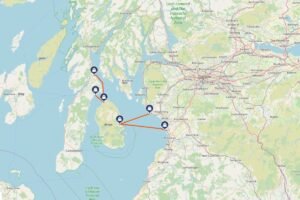
The route map gives you a quick overview of how the crossings fit together. In practice, there are three Arran ferry routes to know:
Route
Typical crossing time
Best for
Ardrossan–Brodick
About 55 minutes
The shortest Brodick crossing, especially useful by train from Glasgow
Troon–Brodick
About 80 minutes
An alternative mainland port for Brodick, but check vehicle restrictions
Claonaig–Lochranza
About 30 minutes
Kintyre, island hopping and the north of Arran
For most visitors, the real decision is Ardrossan or Troon. Ardrossan is usually easier by rail and has the shorter crossing. Troon can be useful when sailings are routed there, but it adds time and has specific restrictions when MV Alfred is operating. If you are already in Kintyre, the small Claonaig–Lochranza ferry can be the neatest route.
Arran ferry services have changed often in recent years, so treat this guide as a route-choice starting point and always check live status before travelling.
Map: ferry routes to the Isle of Arran
Which mainland port should you use: Ardrossan or Troon?
This is the question most travellers now have, and it is worth deciding before you book. Both ports can take you to Brodick, Arran’s main ferry terminal, but they are not interchangeable.
Ardrossan is the shorter crossing at around 55 minutes. The ferry terminal sits next to Ardrossan Harbour station, with direct trains from Glasgow Central. If you are travelling as a foot passenger, or you want the simplest rail-to-ferry connection from the Central Belt, Ardrossan is usually the easier choice when it is available.
Troon is the longer Brodick crossing at around 80 minutes. Troon station is not at the ferry terminal, so foot passengers need to allow extra time for the shuttle bus or onward transfer. By car, the port is also slightly further from Glasgow than Ardrossan.
The biggest practical catch is the vessel restriction. When MV Alfred operates on Troon–Brodick, CalMac says it can carry most vehicle types, but not motorhomes over six metres or any vehicle towing a caravan. If you travel with a motorhome of any size, CalMac asks you to book through its Customer Engagement Centre or the port.
Worth knowing: the Arran service is still changeable. Vessel allocation, port use and disruption advice can shift, especially around the summer timetable and weather. Check CalMac’s Arran route information and live service status before you travel.
Arran ferry timetable, crossing times and fares
Arran ferry times change by season, weather and vessel availability, so the live CalMac timetable is the only source to use for exact departures. For planning, these are the main crossing times:
Route
Crossing time
Booking pattern
Ardrossan–Brodick
About 55 minutes
Book ahead, especially with a vehicle
Troon–Brodick
About 80 minutes
Book ahead, even as a foot passenger
Claonaig–Lochranza
About 30 minutes
Turn up and go, first come first served
Use the booking tool on this page to check departures, availability and fares for your dates. It is especially useful if you are comparing Ardrossan and Troon side by side.
What it costs, and how to keep it simple
CalMac fares are not like airline prices that rise sharply as a sailing fills. The bigger issue is space, especially for cars in summer. Booking early is mainly about securing the sailing you want, not chasing a flash sale. Foot passengers pay much less than cars, and bikes can travel free, but you should still add each bike when booking.
Because the Arran routes are operationally sensitive, check the official timetable and service-status page again shortly before you set off.
This is the classic Arran ferry route. Ardrossan is about a 50-minute drive from Glasgow, and the crossing to Brodick takes about 55 minutes. For foot passengers, the big advantage is the station: Ardrossan Harbour station is right by the ferry terminal, with trains from Glasgow Central.
If you are taking a car in summer, book ahead. Arran is popular, and the bookable vehicle space is what tends to sell out first.
Troon–Brodick
Troon is the other mainland gateway to Brodick. The crossing takes about 80 minutes, so it is roughly 25 minutes longer than Ardrossan–Brodick. It can be a very useful alternative, but it is less convenient by rail because Troon station is not beside the terminal.
When MV Alfred operates this route, remember the restriction: no motorhomes over six metres and no vehicles towing a caravan. Smaller campervans may be possible, but motorhome bookings should be checked with CalMac before you rely on this route. Onboard facilities are also more limited than on a larger ferry, so do not count on a proper hot meal during the crossing.
What about Campbeltown?
There is no Ardrossan–Campbeltown ferry service in the Summer 2026 timetable. If you want to link Arran with Kintyre, the practical ferry route is usually via Lochranza and Claonaig/Tarbert, or by using other Kintyre ferry links such as Portavadie depending on your wider trip. Do not build a 2026 Arran itinerary around an Ardrossan–Campbeltown sailing without checking CalMac first.
The crossing to Lochranza, at the north end of Arran, is a different experience altogether. There is no large terminal here, just a small vehicle ferry you drive or walk straight on and off. It runs from Claonaig in summer and from Tarbert in winter, and the two work differently, so it is worth knowing which one applies to your trip.
In summer, from Claonaig, this is a turn-up-and-go service: you cannot reserve a space on a specific sailing and it works on a first come, first served basis. You can buy a ticket in advance, but it does not act as a reservation for a fixed departure, so on a busy day the practical risk is the ferry filling up rather than a missed booking. Arrive in good time if you have a car.
In winter, from Tarbert, the service is different: Tarbert–Lochranza does require you to book both passengers and vehicles in advance, so do not treat the winter route as turn-up-and-go.
Reaching Claonaig or Tarbert means a fair detour down the Kintyre peninsula, or another ferry to get there, so this route is mainly used by locals, visitors already in the area, and island hoppers stitching together a longer west-coast trip. For most people heading to Arran from Glasgow or the Central Belt, Brodick is still the practical choice.
From Glasgow, Ardrossan is usually the simplest public-transport option because trains run from Glasgow Central to Ardrossan Harbour and the station is right by the ferry terminal. The train journey is around 45 minutes, so the rail connection can work well for foot passengers.
Troon is also reachable from Glasgow by train, but the station is not beside the ferry terminal. CalMac lists a shuttle bus between Troon station and the ferry terminal for foot passengers, so allow extra transfer time and do not cut the connection too fine.
By car, Ardrossan Harbour is just over 30 miles from Glasgow and Troon ferry terminal is about 35 miles. That difference is small on paper, but the crossing time and terminal connection can still make Ardrossan the easier option when both ports have suitable sailings.
About the Isle of Arran
The Isle of Arran sits in the Firth of Clyde and is often described as ‘Scotland in miniature’ for the way it packs mountains, castles, beaches, golf courses, breweries and local food producers onto one manageable island. The line between Highland and Lowland Scotland runs across it, which is part of why the scenery shifts so much from north to south.
Brodick is the main ferry arrival point and the easiest base for many first visits. Lamlash, just to the south, is the island’s administrative centre, while Lochranza gives you a quieter northern arrival if you are coming from Kintyre.
Arran is served by CalMac (Caledonian MacBrayne), Scotland’s main west-coast ferry operator. If Arran is one stop on a bigger trip, our Scotland ferry routes overview and first-hand ferry reviews can help you plan the rest.
Check-in: how early to arrive
For the bookable Brodick routes, aim to arrive at least 30 minutes before departure with a vehicle and 10 minutes before departure as a foot passenger. Late check-in can mean your space is reallocated or your vehicle is refused.
For the Lochranza crossing, check-in is normally closer to 10 minutes before departure for both vehicles and foot passengers. In summer, from Claonaig, it is turn-up-and-go, so the main thing to manage is capacity on a busy day rather than a reserved slot. In winter, from Tarbert, you do need to book passengers and vehicles in advance.
At Troon, allow extra time if you are arriving by train, because the ferry terminal is not beside the station and foot passengers may need the shuttle connection.
Good to know before you sail
Bikes travel free for foot passengers, but add each bike to your booking where the booking process asks for it.
Larger vehicles: when MV Alfred operates Troon–Brodick, motorhomes over six metres and vehicles towing a caravan cannot use that sailing.
Lochranza is different: the northern crossing runs from Claonaig in summer and Tarbert in winter, and it is first come, first served.
Check status on the day: Arran sailings are exposed to weather, tides and vessel changes, so do not rely only on a saved timetable screenshot.
Travelling with children or a dog? A ferry gives you more freedom than a long drive, and our guide on travelling with children covers the practical details.
Independent ferry guidance, not just a route list.
FerryGoGo is an independent ferry guide, not CalMac or an official timetable source. Arran’s ferry set-up has been unusually changeable, so we check the official route pages, service-status updates and booking information when updating this guide. We have not sailed this Arran crossing ourselves yet, so we do not present this as a first-hand review.











Where is the best place to leave a car if going on the ferry with cycles
Hi Simon,
You can find a bit more about parking on this page: https://www.calmac.co.uk/article/7749/Is-there-free-parking-at-the-port
Good luck!